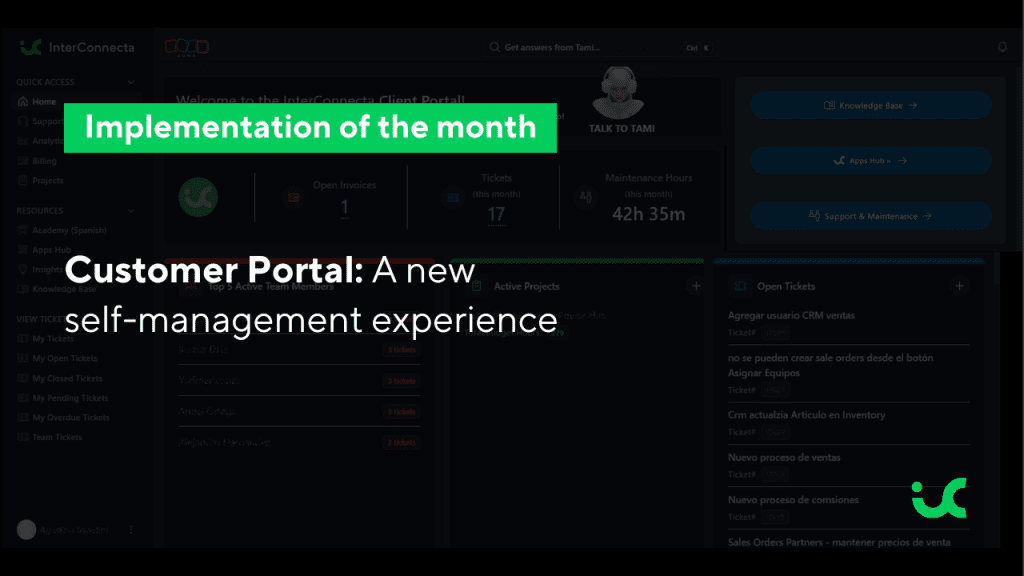
In the constant pursuit of improving the customer experience and optimizing service management, the Customer Portal was implemented exclusively for InterConnecta clients and partners. This portal provides immediate access to invoices, support tickets, project management, and key resources, all in one place.
Challenge
Before implementing a Customer Portal, many companies face the following issues:
Difficulty in centralizing billing information, tickets, and projects in one place.
Lack of quick access to documentation and technical guides for autonomous issue resolution.
Unstructured support request processes, leading to delays in incident resolution.
Need for a system that allows better tracking of team interactions with contracted services.
Solution
To overcome these challenges, a Customer Portal was developed with the following features:
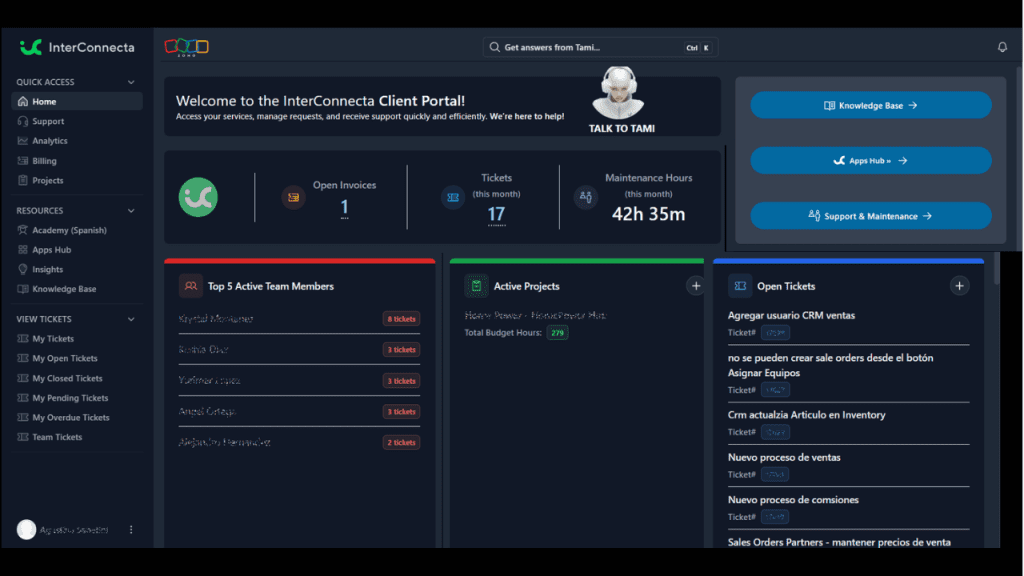
Intuitive Dashboard: Provides a quick overview of open invoices, pending tickets, active projects, and the most active team members.
Quick Navigation Menu: Direct access to Home, Support, Analytics, Billing, and Projects.
Ticket Manager: Allows users to create support requests in two categories—Incident Request and Project Request—with detailed forms for better management.
Integrated Knowledge Base: Provides documentation, tutorials, and explanatory videos on available tools and solutions.
Intelligent Virtual Assistant (Tami): Available 24/7 to answer questions and facilitate portal navigation.
Apps Hub: A space where users can discover additional tools to optimize their business management.
Benefits
Implementing a Customer Portal for your clients will bring significant improvements in service and support management:
Greater user autonomy: Clients can access key information and resolve inquiries without direct support contact.
Reduced response times: Thanks to ticket categorization and Tami’s availability, resolution times have been optimized.
Centralized information: Everything needed for service management, from invoices to ongoing projects, is in one place.
Better tracking and control: Users can clearly view the status of their tickets, service usage, and available resources.
Access to tools and training: Through the Knowledge Base and Apps Hub, clients can enhance their Zoho experience at no additional cost.
The Customer Portal has become a key tool for self-management and optimization of Zoho usage. With this implementation, users gain more efficient access to services, support, and resources, giving them full control of their experience in a simple and effective way.
If your company uses Zoho and you want to offer a Customer Portal for your clients to have centralized access to billing, support, and projects, we can help you implement it! Contact us to learn how to integrate this solution into your business and enhance your customers’ experience.
A leading company in solar panel installation, with over 3,000 employees and a support team of more than 20 people, was facing challenges in managing technical visits and home maintenance. With a fleet of more than 50 service brigades and over 1,000 work orders per month, the lack of a unified system for managing visits and invoicing led to inefficiencies, errors, and high operational costs.
Challenges:
Lack of integration between ticket management and work order systems.
Dispersed and duplicated information, affecting efficiency and accuracy.
Delays in customer service due to lack of real-time data access.
High operational costs due to manual processes.
Inefficient allocation of technical resources due to the absence of a unified calendar.
Lack of visibility into service orders and multiple visits.
Solution
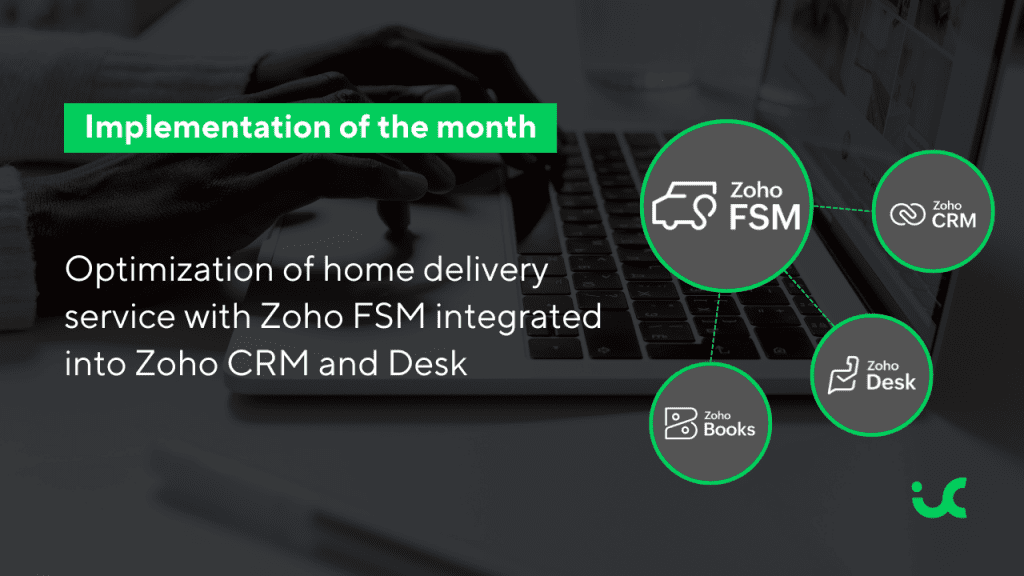
To overcome these challenges, the company implemented Zoho FSM, integrated with Zoho CRM and Zoho Desk, optimizing technical support management through:
Integration with Zoho CRM, Zoho Desk, and Zoho Books, streamlining service order creation and invoicing.
Automated resource allocation via a centralized calendar.
Mobile application allowing technicians to access key information, even offline.
Centralized data, enabling dispatchers and technicians to manage the entire service cycle on a single platform.
Service order generation from Zoho Desk, reducing response times.
Automated reports and dashboards for real-time monitoring.
What is Zoho FSM?
Zoho FSM (Field Service Management) is an application designed to manage and optimize field technical services. It enables task scheduling, resource allocation, equipment tracking, inventory management, invoicing, and report automation. It is ideal for maintenance, installation, and technical support companies, improving operational efficiency, reducing errors, and optimizing response times.
Benefits
Since implementing Zoho FSM, the company has achieved:
✅ 30% increase in revenue in the first month, optimizing cash flow. ✅ Greater operational efficiency, reducing administrative times. ✅ Error reduction, eliminating manual tasks in order management. ✅ Improved customer experience, with faster response times. ✅ Better inventory control, ensuring accurate invoicing of spare parts and materials. ✅ More transparency and visibility, optimizing field team management.
The implementation of Zoho FSM enabled the company to efficiently manage its technical service operations, optimizing every stage of the process and significantly reducing operational costs. The solution provided greater autonomy to teams and improved accuracy and transparency in home service management.
A leading company in the renewable energy industry faced significant challenges in managing its external sales teams. With a business model involving multiple agencies and external teams, they lacked a centralized solution to manage leads, opportunities, and sales orders. This situation resulted in inefficiencies, errors, and disorganization, negatively impacting their commercial performance.
To address these issues, the company implemented Sales Portal, a solution developed by InterConnecta designed to optimize external sales management and synchronize in real time with Zoho CRM.
Challenge
The company encountered several key obstacles in its external sales process:
Lack of a centralized system: External teams lacked a robust tool to record and follow up on leads, leading to scattered and duplicated information.
Disconnect between internal and external teams: The lack of real-time visibility caused delays in data updates and hindered strategic decision-making.
Manual and inefficient processes: The absence of proper tools made it difficult to progress in the sales cycle, delaying the conversion of leads into clients.
High operational costs: Providing Zoho CRM licenses to all external users was financially unsustainable.
Solution
InterConnecta implemented Sales Portal, a platform specifically designed for external users without Zoho CRM licenses. The solution included the following key features:
Controlled access: Users access the portal via a personalized URL with specific credentials.
Real-time synchronization: All data is automatically synchronized with Zoho CRM, ensuring consistency and accuracy.
Customizable roles: Roles such as Agency Admin and Agency User were assigned to manage permissions based on levels of responsibility.
Integrated task management: Tools to create tasks, schedule meetings, and attach documents directly within the portal.
Process automation: Direct generation of sales orders that are seamlessly reflected in Zoho CRM.
Benefits
The implementation of Sales Portal had a significant impact on the company’s processes and results:
Greater operational efficiency: Centralizing sales activities reduced time spent on administrative tasks, allowing teams to focus on client relationships.
Improved customer experience: An optimized workflow enabled faster responses to customer needs, increasing satisfaction.
Error reduction: Automation eliminated manual errors, ensuring accuracy in managing leads, contacts, and sales orders.
Increased transparency and control: Agency Admins gained full visibility over their teams’ activities, while Agency Users efficiently managed their own records.
Cost reduction: By eliminating the need for additional Zoho CRM licenses, the company optimized its financial resources.
Sales Portal enabled the renewable energy company to transform the management of its external teams, achieving efficiency, transparency, and cost reduction. This solution not only optimized every stage of the sales cycle but also strengthened collaboration between internal and external teams, ensuring sustainable results in the long term.
InterConnecta remains a leader in implementing innovative solutions like Sales Portal, adapting to the specific needs of diverse industries to maximize team and process performance.
Looking for customized solutions to optimize your business? We’re ready to help. Contact us!
A major company in the renewable energy sector was facing critical challenges in commission management for its large sales team, which includes over 1,000 internal and external salespeople. The complexity of different compensation plans, deductions, and variable targets led to frequent errors in commission calculations, impacting operational efficiency, team morale, and payment accuracy. To address these issues and improve transparency in commission management, the company decided to implement the commission tool developed by InterConnecta.
Challenges The company’s sales team operated under diverse compensation structures, increasing the likelihood of errors in manual calculations. Additionally, the volume of data that had to be processed daily—such as sales, achieved targets, and project stages—was overwhelming for the finance team.
Key challenges included:
Complex manual calculations: Different compensation plans with bonuses and deductions led to errors.
Lack of automation: The absence of an automated process hindered workflow and increased the risk of human errors.
Limited visibility: Salespeople did not have real-time access to their commissions, which reduced trust in the system and affected motivation.
Regulatory compliance: Manual management of tax withholdings increased the risk of tax errors and penalties.
Solution InterConnecta implemented a customized solution through its commission management tool. This system was fully integrated with Zoho CRM and other key systems, automating calculations and improving payment accuracy.
Key features of the solution included:
Automation of complex calculations: Adapting to various compensation plans, the tool eliminated human errors, reducing processing time by 50%.
Real-time visibility: Salespeople gained immediate access to their commissions, which increased transparency and motivation.
Guaranteed regulatory compliance: Automation of tax withholdings and other deductions ensured compliance with local regulations.
The implementation of InterConnecta’s commission tool brought significant improvements to the company’s operations:
Reduction of calculation errors: Commission errors were virtually eliminated, enhancing accuracy and reducing disputes.
Timely and accurate payments: Automation ensured that all salespeople received their payments on time, improving team morale.
Faster, more efficient processes: Time spent on commission calculations was halved, allowing the finance team to focus on more strategic tasks.
More informed decision-making: The integration of financial and sales data enabled the company to make more precise, timely strategic decisions.
InterConnecta’s commission tool transformed the company’s commission management, optimizing processes, increasing transparency and team motivation, and ensuring compliance with tax regulations. This solution has enabled efficient and accurate commission management, contributing to the company’s sustainable growth in a highly competitive market.
In this new edition of Implementation of the Month, we highlight a custom integration solution we developed for a client in the high-value hobby e-commerce industry. Through this implementation, we addressed challenges that arose from the limitations of the native integration between Zoho Inventory and Shopify.
Challenge:
Our client managed most of their internal operations through Zoho One applications while using Shopify as their e-commerce platform. Although the native integration between Shopify and Zoho Inventory allowed for the automatic creation of Sales Orders, it presented several key challenges:
Manual intervention in invoice creation and payment assignment: After a sales order was created in Zoho Inventory, manual intervention was required to complete invoice creation and assign the corresponding payments.
Lack of automation in cancellation management: Order cancellations required manual processes to return products to inventory and void the corresponding transactions.
Inefficiencies in delivery management: The Service team managed deliveries outside of the automated flow, causing delays in scheduling and execution.
Solution:
As a Premium Partner of Zoho, InterConnecta designed a custom integration using Zoho Inventory and Shopify APIs. This solution focused on optimizing two key areas that were not fully covered by the standard integration: cancellation management and automated delivery order creation.
Automatic Cancellation Management in Shopify
One of the main limitations was the sales cancellation process. The custom integration solved this challenge by creating an automated workflow that, upon detecting a cancellation in Shopify, would void the corresponding invoice and payment in Zoho Inventory. The stock of canceled products was updated in real time, making the items available for future sales.
Optimized Delivery Management with Delivery Charges
The second challenge was integrating delivery charges into the automated sales and delivery flow. To achieve this, we created an item called “Delivery” within Zoho Inventory. When a Shopify order included this charge, the system would automatically add the item to the Sales Order, which in turn generated a delivery ticket in Zoho Desk. This way, the service team would immediately receive an assigned task to manage the delivery, optimizing response time without waiting for daily reconciliations.
Benefits:
The implemented solution provided several key benefits:
Real-time inventory: Canceled products were put back on sale immediately, improving inventory management and sales opportunities.
Delivery efficiency: Automated tickets sped up the delivery process, optimizing coordination of the service team.
Improved customer experience: Quick management of cancellations and deliveries enhanced customer satisfaction.
The custom integration developed by our team allowed the client to overcome the limitations of the standard integration between Zoho Inventory and Shopify.
This case is an example of how, through customization and strategic use of Zoho tools, we help our clients optimize their operations and resources.
Is your company facing a challenge that seeks to be overcome through the implementation of custom solutions? We’re here to help you turn those challenges into opportunities. Contact us today!
En esta nueva de edición de Implementación del Mes, destacamos una solución de integración personalizada que desarrollamos para un cliente en la industria de e-commerce de hobbies de alto valor. A través de esta implementación, resolvimos desafíos que surgieron de las limitaciones de la integración nativa entre Zoho Inventory y Shopify.
Desafío:
Nuestro cliente gestionaba la mayor parte de sus operaciones internas a través de las aplicaciones de Zoho One, mientras utilizaba Shopify como su plataforma de e-commerce. Aunque la integración nativa entre Shopify y Zoho Inventory permitía la creación automática de Sales Orders (órdenes de venta), presentaba varios desafíos clave:
Intervención manual en la creación de facturas y asignación de pagos: Después de que se creaba una orden de venta en Zoho Inventory, era necesario intervenir manualmente para completar la creación de facturas y asignar los pagos correspondientes.
Falta de automatización en la gestión de cancelaciones: La cancelación de órdenes requería procesos manuales para devolver productos al inventario y anular las transacciones correspondientes.
Ineficiencias en la gestión de entregas: El área de Servicio gestionaba las entregas fuera del flujo automatizado, lo que generaba retrasos en la programación y ejecución de las mismas.
Solución:
InterConnecta, como Partner Premium de Zoho, diseñó una integración personalizada utilizando las APIs de Zoho Inventory y Shopify. Esta solución se enfocó en optimizar dos áreas clave que no estaban completamente cubiertas por la integración estándar: la gestión de cancelaciones y la creación automatizada de órdenes de entrega.
1. Gestión automática de Cancelaciones en Shopify
Una de las limitaciones principales era el proceso de cancelación de ventas. La integración personalizada resolvió este desafío creando un flujo automatizado que, al detectarse una cancelación en Shopify, se encargaba de anular la factura y el pago correspondiente en Zoho Inventory. El stock de los productos cancelados se actualizaba en tiempo real, liberando los artículos y volviéndolos a poner a disposición para futuras ventas.
2. Optimización de la Gestión de Entregas con Cargos de Delivery
El segundo reto fue integrar el cobro por delivery en el flujo automatizado de ventas y entregas. Para lograrlo, creamos un ítem llamado “Entrega” dentro de Zoho Inventory. Cuando una orden de Shopify incluía este cargo, el sistema añadía automáticamente dicho ítem al Sales Order, lo que a su vez generaba un ticket de entrega en Zoho Desk. De esta manera, el equipo de servicio técnico recibía inmediatamente una tarea asignada para gestionar la entrega, optimizando así el tiempo de respuesta sin tener que esperar las conciliaciones diarias.
Beneficios:
La solución implementada brindó varios beneficios clave:
Automatización completa: La centralización de procesos en Zoho Inventory eliminó tareas manuales, reduciendo los tiempos de respuesta.
Inventario en tiempo real: Los productos cancelados se volvieron a poner en venta inmediatamente, mejorando la gestión del inventario y las oportunidades de venta.
Eficiencia en entregas: Los tickets automáticos aceleraron el proceso de entrega, optimizando la coordinación del equipo de servicio técnico.
Mejor experiencia del cliente: La rápida gestión de cancelaciones y entregas mejoró la satisfacción de los clientes.
La integración personalizada desarrollada por nuestro equipo permitió al cliente superar las limitaciones de la integración estándar entre Zoho Inventory y Shopify.
Este caso es un ejemplo de cómo, mediante la personalización y el uso estratégico de las herramientas de Zoho, ayudamos a nuestros clientes a optimizar sus operaciones y sus recursos.
¿Está tu empresa enfrentando un desafío que busca superar mediante la implementación de soluciones personalizadas? Estamos aquí para ayudarte a transformar esos retos en oportunidades. Contáctanos hoy!
This month, we highlight an implementation carried out by our team for a leading company in the sale of high-value products with serial numbers, which needed to optimize its processes within Zoho Inventory.
Challenge:
The company relied on a manual process that required multiple steps:
Registering customers one by one
Creating sales orders
Scanning product serial numbers
Managing shipments and income
This process took between 5 and 10 minutes per transaction.
The prolonged time, combined with the risk of human errors, reduced operational efficiency and affected customer satisfaction.
Solution:
To address these challenges, we developed a custom application specifically designed to automate and streamline manual processes within Zoho Inventory.
The application allows for:
Customer Registration Automation: The application requests the customer’s phone number and automatically searches the database. If not registered, it quickly collects the necessary information to complete their profile.
Sales Management Optimization: Depending on the type of delivery, the application allows scanning of serial numbers and automatically lists the products in Zoho Inventory. For immediate deliveries, the entire process is managed in an automated flow.
Future Delivery Management: Customers can choose the date and place of pick-up and designate the responsible person. The application automates the creation of sales orders, manages payments, and completes the process at the time of delivery.
Payment and Digital Signature Integration: The application facilitates payment, including available credits, and allows for a digital signature, reducing the need for manual intervention.
Instant Communication: Upon completion, the customer receives an SMS and an email with the purchase receipt, warranty documents, and delivery confirmation.
Benefits:
The implementation of the custom application by InterConnecta generated a series of significant improvements:
Time Reduction: The InterConnecta application reduced the transaction time from 5-10 minutes to less than 1 minute.
Error Reduction: Automation significantly reduced human errors.
Customer Satisfaction Improvement: Speed and accuracy improved the customer experience and increased loyalty.
Operational Efficiency: The company was able to handle more transactions without increasing staff, optimizing its resources.
The implementation of this custom application in Zoho Inventory, developed by InterConnecta, not only solved the client’s key operational issues but also enhanced efficiency and accuracy in inventory and sales management. This solution reinforces InterConnecta’s position as a leader in developing advanced solutions within the Zoho environment, capable of adapting to each client’s specific needs and taking their operations to the next level.
This is another example of how our solutions can transform and optimize a company’s operations. If you are interested in discovering how we can help you implement innovative technological solutions in your business, don’t hesitate to contact us.
This month, we highlight an implementation carried out by our team for a leading solar energy company in Puerto Rico.
Challenge
The company faced several operational challenges:
Dispersed customer data and ineffective lead tracking.
Manual and lengthy sales processes.
Inefficient campaign management and lack of ROI tracking.
Complex project planning and scheduling.
Laborious financial management and inaccurate project cost tracking.
Inefficient inventory management and lack of visibility in the supply chain.
Inefficient handling of customer support tickets and coordination of field service work.
Solution
To address these challenges, we proposed a comprehensive solution using Zoho. The project began in September 2019 with the implementation of Zoho CRM for a small team of 4 users, which allowed for the centralization of customer data and improved relationship management. In January 2022, the company expanded its use to Zoho One, increasing the user base to 745 employees and over 300 external subcontractors. This complete suite included Zoho CRM, Zoho Sign, Zoho Social, Zoho Analytics, Zoho Books, Zoho Inventory, Zoho Desk, and Zoho Creator, all integrated to support their complex operations.
Benefits
The implementation of the Zoho Suite and the services offered by InterConnecta brought several key benefits:
Automation: Numerous manual processes were eliminated, significantly reducing the time spent on administrative tasks.
Integration: The integration of various applications allowed for a holistic view of operations, improving coordination between departments.
Continuous Training: We provided ongoing online and in-person training, ensuring that staff were well-prepared to use the new tools and processes.
Support and Maintenance: Our team provided daily support and ongoing maintenance, ensuring that any issues were addressed quickly, keeping operations running smoothly.
The adoption of Zoho One not only allowed for greater operational efficiency but also improved customer satisfaction by providing faster and more accurate service.
Conclusion
Our client was able to significantly transform their operations thanks to the implementation of Zoho, demonstrating a commitment to innovation and excellence in the solar energy sector. The collaboration with our team not only optimized their processes but also positioned the company for continuous growth and success in a competitive market.
This is just one of many examples of how our solutions can transform and improve the way businesses operate. If you would like to learn more about how we can help you implement innovative technological solutions in your company, please do not hesitate to contact us.
This month, we highlight an implementation carried out by our team for a world-renowned leader in public art and architectural design solutions.
Challenge
The client needed a solution that could automate the synthesis of detailed project information, as the manual process was inefficient and prone to errors. The task was clear: to improve both efficiency and accuracy in project management.
Solution
We proposed the implementation of artificial intelligence, specifically ChatGPT integrated with Zoho Creator, to automate the creation of project summaries from detailed forms. By leveraging the powerful APIs of OpenAI and Zoho Creator, we designed a system that automatically generated and sent project summaries on demand. This solution involved simply pressing the “AI Summary” button in the Zoho Creator Quotation Form, which activated the processing of the form fields to produce complete HTML email summaries.
Benefits
The implementation brought numerous benefits:
Efficiency: Automation eliminated the manual process, saving significant time in creating summaries.
Accuracy: Standardization in data analysis reduced human errors, ensuring the accuracy of information.
On-demand availability: Summaries could be generated instantly with the most recent data, facilitating timely updates and agile decisions.
The integration of ChatGPT with Zoho Creator not only saved time but also improved the flow of information between departments, fostering more informed decision-making and efficient project oversight.
Thanks to this collaboration, our client was able to successfully leverage artificial intelligence to enhance their project management efficiency, demonstrating a firm commitment to innovation and excellence in their architectural design and public art solutions.
This is just one of many examples of how Interconnecta is transforming project management through innovative and customized solutions! For more information on how we can help you implement innovative technological solutions in your company, contact us.
The usability of a CRM tends to be the first sacrifice made when attempting to account for every sales action and task in a sales cycle. Though it may seem like a necessary sacrifice at first, you will likely come to find that the data within your CRM suffers as a result.
More specifically, you may discover that sales reps will only enter information in your CRM at the end of a sales cycle in order to circumvent the pesky data entry experience. Not only will your forecast be inaccurate, but you will also lose the opportunity to gain valuable insights into the success of your sales process as a whole.
Fortunately, if configured thoughtfully, you do not need to sacrifice the usability of your CRM to handle the complexity of your sales cycle (or cycles!). Below are three important things to consider during your configuration process.
1. Quality, Then Quantity
You’ve probably heard that a CRM should not have more than “insert number here” custom fields. But while quantity is important, quality should be your first concern. Focusing on quality will not only ensure that your fields are meaningful, but typically results in a manageable amount of fields as a result.
For example, you may ask yourself, how do we currently segment our customers? By size? By location? A field for the answer is likely necessary in your CRM as you should be able to easily filter your prospects within your CRM by these qualifications.
Another useful question: how would you describe your best customer or prospect, and what information do you know about them? Fields pertaining to your answer should likely be leveraged within your CRM as well.
2. Big Buckets
When it comes to the milestones within your sales process, quantity becomes more important. Though your sales process may be multifaceted, try separating it into fewer, larger buckets.
For example, if there are many steps your reps – or even non-sales employees – must take in order to register a new customer, you probably don’t need a stage for each step. Instead, try a general “Customer Registration” stage with custom fields to capture each of the important steps on the way to this larger registration milestone.
Now, with a clearer distinction between stages, and firm exit criteria between them, your sales reps will always know where they stand in their process, no matter how convoluted it may be.
3. Goals
Without a guiding north star, all the thought put into the configuration of your CRM could be rendered useless. Especially with a complicated sales process, your sales reps need a clear goal to refer to when things get cloudy.
This goal should be obvious within your CRM, whether it’s on the dashboard or in reports. Some of our customers leverage the Sales Goal report, casting it live on their sales floor. No more mass data entry at the end of a deal cycle; instead, your representatives will know their goal and be motivated to enter in forecast data to see how they are tracking toward it.
Configuring a CRM to handle the complexity of your sales cycle without sacrificing usability may seem like a daunting task. The tips above should help in the process; however, your CRM can only be as “user-friendly” as the CRM software you use.
Moreover, your reports and forecasts are only as accurate as the data within them. Your CRM will only contain accurate data if it is easy to use. With thoughtful configuration of a user-friendly CRM, you will not only increase the accuracy of your forecast but likely your sales in general.