Category: CRM

  • Benefits of Using CRM in Businesses

    Customer Relationship Management (CRM) systems have been around for years and they’re here to stay. These are constantly renewed to integrate and optimize the business operations that companies have on a daily basis. However, there is still a percentage of them that do not have a cloud-based CRM and are limited by software that is not integrated, causing employees a delay in information access. According to Grand View Research, 91% of companies with ten or more employees use CRM; while the pandemic significantly accelerated the demand for CRM, whose value reached $52.64 million in 2020, according to Fortune Business Insights.

    Image by Pixabay via Pexels

    Image by Pixabay via PexelsThat said, not having a based-cloud CRM at this point is a huge disadvantage for any business, especially in times where remote accessibility is equally necessary for employees and customers. Although spreadsheets, for example, are always available on computers, they do not have all the required functions to keep customer information organized and up-to-date. Therefore, they do not offer a complete context of the status of each lead or deal.

    If you’re still thinking about implementing a CRM in your business, we will break down the following benefits that you can get with it:

    Centralized Database

    A CRM gathers all your customers’ information in a single place. Data such as name, company, deals, call and/or email history, purchased products, support requests, among others, are displayed in each customer profile. This offers total context to you and your agents in order to know the situation of each customer at any time, and without having to search throughout different files.

    Complete and Refined Information

    There’s no question that avoiding duplicates and incomplete information in a document is very difficult and time-consuming. It can even contribute to making mistakes and lowering productivity. Systems like Zoho CRM allow you to mark required fields to reduce misinformation and human error. It is precisely this last factor the reason why CRMs can detect if the data was previously recorded, thus avoiding duplicates or allowing the merging of records to keep only one with the correct data.

    Connection Between Marketing and Sales

    Marketing and sales always go hand in hand, which is no exception in the CRM. This system integrates your marketing and sales channels, and allows you to quickly add new prospects to your database.

    An example of this integration is that you can connect your CRM to a form within your web page to add all the records to your database. In addition, you can integrate it with the contacts’ social network profiles and email addresses to add new records from these channels. Thus, you will be able to have complete visibility of those channels with higher conversion rates, follow closely the ROI, and constantly gain new potentials.

    CRM allows you to connect your phone service to contact your customers from it. Image by SHVETS production via Pexels

    Farewell to Missed Calls!

    Connect your phone service to contact your customers from your CRM. You can also set reminders to ensure follow-up to all leads and contacts. One of the advantages of Zoho CRM is that besides that option, it also allows you to integrate it with various applications —such as WhatsApp— to contact your customers through their preferred channels.

    Automate to Save Time

    Thank goodness for automation! You can automate routine tasks like lead assignment or sending emails. This way, your team will save time and can focus more on serving their customers and closing more deals.

    Clarity in Sales Processes

    A CRM system allows you to minimize errors in the new team members’ training through the Blueprints function in Zoho CRM. This allows to detail the sales process within the platform and pushes the team to follow all the steps of the blueprint, in order to achieve a uniform and functional process.

    Automatic Reports and Forecasts

    The CRM allows you to create monthly, quarterly, annual reports or any period of time by selecting the dates you need to see. In addition, you have the option of scheduling them so that the people you select receive them periodically via email. Another very useful function is to obtain monthly or quarterly sales forecasts at any time.

    CRM Systems Allow You to Work from Anywhere

    Zoho applications allow you to access your CRM from any device connected to the internet, including your mobile phone with the Android and iOS application. Thanks to this accessibility, your teams can work remotely and consult the information they need no matter where they are.

    Sales and Customer Retention Increase

    In conclusion, all the advantages of CRM result in having more time to contact and better serve prospects and customers. This translates into more sales and greater customer retention, thus achieving the success of your business and your team.

    To see the original source of this article, click here.

    Do you need help with your Zoho CRM or are you considering implementing it in your business? Contact us or sign up for a Zoho CRM trial.


  • Three Current CRM Trends for Better Engaging Your Customers

    Despite being a 30-year-old technology, the CRM (customer relationship management) industry keeps growing at an astonishing rate. It has proven to be the core of all companies, even more so during the pandemic. Using CRM software enables businesses to have 360-degree views of customers in real time. This allows to push customer experiences that are personal, in context, and trustworthy. To achieve that, check out the following CRM trends that can help you improve customer engagement:

    Image by Jenny Ueberberg via Unsplash

    Multichannel Engagement

    It’s been a while since customers have moved towards digital self-service for sales and to get customer service. There’s now a shift within that category: engagement is moving away from businesses’ websites and their digital channels to third-party, digital touchpoints like asynchronous messaging channels, voice apps, social media, and gaming consoles.

    A great case study for that is David’s Bridal. This retailer made $30,000 in sales with a chat system in the first couple of weeks after launch. Now, in 2021, companies are testing conversational commerce to achieve contextual engagement that is consistent over any touchpoint or channel, whether it’s owned or not.

    Customer Hyper-Personalization

    Because customers anticipate an engagement that’s tailored according to their preferences, context, history, and intent; they need to receive contents, connections, journeys, and offers that are extremely personal and made with cutting edge resources. These experiences are now being built by companies throughout slim channel sets and stages in the customers’ journeys. Information like buying indicators, social data, relationship graphs, demographics, and life events is now incorporated into those journeys. This is done with the purpose of deepening relationships with customers, stimulating loyalty, and engaging customers in a unique way.

    An Empowered Customer Frontline with Customer Data and Insights

    Two key elements in the success of a company are renewals and expansions, particularly in times of economic uncertainty. Therefore, companies must give special attention to adequate deployment, onboarding, and ongoing customer success to push predictable revenue.

    According to a survey by Forrester, the chief customer officer (CCO) will rise by being responsible for post-purchase activities, particularly at B2B companies. 59% of the CCOs interviewed by Forrester stated that revenue growth is a high or essential business priority. Because the lines of CRM technologies, customer success, and onboarding are now blurring, this will deliver a better view to all frontline staffs of the customer’s value to the company and qualities that influence a stir. So, democratized customer data and insights will be available when and where any frontline employee needs them, like in office productivity tools or collaborative workspaces. Moreover, there will be an arise of new CRM licensing models that center on software consumption.

    To read the full article, click here.

    Do you need help with your Zoho CRM or are you considering implementing it in your business? Then click here and sign up for a Zoho CRM trial.

  • Technology Will Play an Important Role in Reactivating Tourism

    As we’ve already seen, the pandemic has affected many industries, with tourism experiencing a huge impact. Cancellations of national and international flights, massive events postponed because of mobility restrictions, and restaurants closing were some of the factors that affected growth and productivity in the tourism industry.

    Image by Ketut Subiyanto via Pexels

    “When the crisis landed in concrete examples, we found that all the airline companies showed major financial setbacks boosted by the strict health measures and fear of people using their services, mostly. For example, Latam Airlines registered net losses of $4,545 million dollars in the last year, which confirms the strong impact of the pandemic,” said Raju Vegesna, Chief Evangelist at Zoho Corporation.

    Therefore, the industry’s worries are more than valid. According to the World Travel & Tourism Council, the tourism sector represents 10.4% of the global economic growth and it generates about 319 million job openings, which is equivalent to 10% of employment in the world.

    To achieve a strong comeback from the tourism industry, it is necessary to strengthen the implementation of new technologies to reduce the risks that still remain, offer more trust to travelers, and optimize the travel experience in its entirety with high-end technologies, like the ones disclosed below.

    Contactless Systems

    What used to be a mere novelty has now become a necessity. It is recommended to avoid that tourists have any physical contact with all kinds of devices, like touchscreens, payment terminals, or computers for registration. To accomplish that, digital platforms in the cloud can be implemented to allow travelers to get self-services for all the operations through apps or QR codes. Other key digital services are hotel bookings and flights that guarantee the required capacity.

    CRM Platforms

    When reactivating tourism, it’ll be imperative to have CRM (Customer Relationship Management) platforms to identify in a deeper way the consumer patterns of customers to anticipate their needs, with the purpose of elaborating strategies to diversify and supplement services. This will allow to learn the users’ requirements and to offer them customized experiences based on their needs.

    Apps for Commercial Operations Management

    It must be kept in mind that the wellbeing of the work staff is essential for a company’s productivity. Nowadays, technology and app integrations allow the industry to monitor the workers’ health with the purpose of avoiding future infections of COVID-19.

    “History has demonstrated that after crisis periods, new phases of sustained growth arrive. I’m sure that reactivating tourism will be a reality, as long as growth routes are designed with technology opportunities as a central axis,” added Vegesna.

    To read the full article, click here.

    Are you considering implementing Zoho CRM in your business? Then click here and sign up for a free trial of Zoho CRM.

  • Zoho is Named a Leader in Nucleus Research CRM Technology Value Matrix 2021

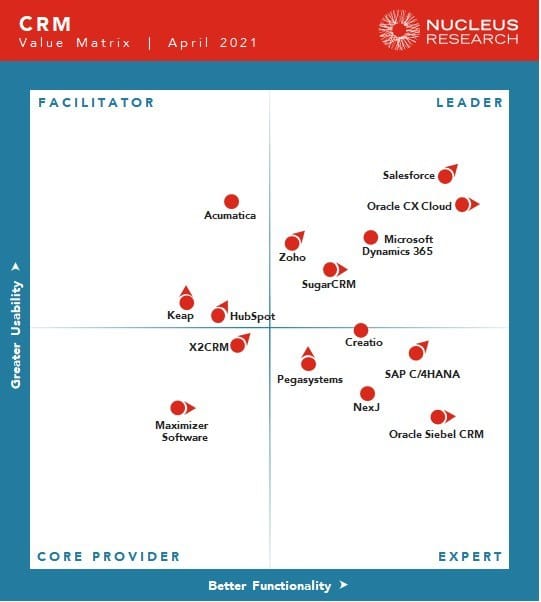
    Just a few months after being named in all four Gartner Magic Quadrants, Zoho achieves another prestigious recognition by being named a Leader in the Nucleus Research CRM Technology Value Matrix 2021.

    Image via Nucleus Research

    Nucleus Research, a global provider of ROI-focused technology research and advisory services, generates their Value Matrix based on in-depth interviews with end users and customers, vendor participation, and extensive ROI assessments of technology deployments. The vendors’ assessment is based on usability and functionality, two of the key factors that give impulse to long-term value.

    In their Value Matrix report, Nucleus Research stated the following:

    “With the breadth and customizability of the Zoho platform, customers can truly run their entire businesses with Zoho. This puts Zoho into a league of behemoth technology vendors like Microsoft, Salesforce, and Oracle. We have consistently seen Zoho move upmarket as the platform has increased in breadth and capability, to where now it is a viable platform for enterprise-size organizations around the world.”

    The Miami-based technology research company also mentioned that “two increasingly compelling reasons” to partner with Zoho are its unified data model and private cloud approach, both of which separate Zoho from its competitors. Nucleus Research explains that the unified data model enables cross-departmental visibility and process integration, something that has become crucial during pandemic times as more work is done from distributed settings. “The ability to integrate data and unify business areas on a single platform will come increasingly into demand”, reveals the report.

    Nucleus Research also praises Zoho’s quick innovation pace and product development, which results in being well positioned to gain market share from customers who seek a lower-risk approach to heighten CRM sophistication, as well as the modernization of legacy deployments. All these elements plus a functionality that’s complete and competitive, fast deployment times, and endless customization and process digitization potential, are the qualifications that make Zoho a Leader in 2021’s Value Matrix.

    To read the full article, click here.

    Are you interested in learning more about Zoho’s applications or implementing them in your business? Then reach out to us by clicking here. We’ll be happy to help!

  • The Three C’s of CRM Data Optimization

    Crucial, correct, and consistent: that’s how your CRM data should be.

    Those are “the three C’s” of CRM data optimization. However, not all companies have those characteristics. According to an IBM report, one in three business leaders mistrust their data quality, while companies from the United States lose about $3.1 trillion in annual revenue because of bad data.

    To save your business from falling into a bad data rabbit hole, check out these tips on how to make sure that your data is crucial, correct, and consistent:

    Image by Luke Chesser via Unsplash

    Make it Crucial

    Each and every field must have a reason for existing for data collection. Having too many fields that are not justified can cause to capture more data than needed. In order to identify the actionable data that your business really needs, you must work with your organization’s departments and stakeholders. Once you do that, express your reasoning to all the CRM users so they can understand what data is needed and its importance. A great way of communicating this is adding information bubbles to each field with a short explanation.

    Make it Correct

    Unfortunately, data expires quickly. A report from Dun & Bradstreet from 2018 revealed that every hour 13 companies would change their names, 211 businesses would move, 429 business phone numbers would change or be disconnected, and 284 company CEOs or owners would change.

    Since people won’t tell you to update your data, you must do it and verify it yourself. You can identify records that can’t be contacted and flag open opportunities they’re associated with to understand why an opportunity is open over its close date. By doing this, you’ll be able to locate at-risk opportunities before their close dates arrives to pass without any sale.

    You might also want to consider streamlining your CRM’s user interface if it’s complicated. This will allow you to increase productivity and the chances that your data will be accurate, complete, and entered on time. Also, it helps when CRM users comprehend the consequences of having data that’s inaccurate and incomplete. For example, a missing job title or job level might result in a quality lead getting overlooked or not properly scored.

    Image by Lukas via Pexels

    Make it Consistent

    The Gartner State of Sales Analytics report from December 2020 revealed that only 25% of businesses had a standard and organization-wide definition for sales metrics, which is a core aspect to any businesses. It’s essential to create standardized definitions, as well as making sure that everyone uses them. With that in mind, your data must be stylized in a reportable and functional way. This includes eliminating duplicates (a constant in any CRM) and making sure that your CRM is usable for all stakeholders. Ask yourself: Can executives analyze data easily? Is the sales team able to easily manage its pipeline and generate forecasts? Also, is customer support able to access everything they need to manage cases in an efficient manner? If your answers are no, then you might have to improve your data to be more actionable and accessible.

    Making it Crucial, Correct, and Consistent is an Ongoing Process

    CRM data optimization isn’t a one-time only activity. It is an ongoing and strategic process of maintaining and monitoring your data. To ensure that better-quality data will enter the system, you must educate your CRM users and make easier their data entry process. Once you focus on the three C’s to have the right and consistent data, your CRM users will feel confident when using the correct data and they will be able to do their jobs seamlessly and with positive results.

    To read the full article, click here.

    Do you need help with your Zoho CRM or are you considering implementing it in your business? Then click here and sign up for a trial of Zoho CRM.

  • CRM in 2021: Trends and Predictions

    It is safe to say that, because of the unprecedented year that 2020 was for the entire world, everybody is curious and anxious about the future. CRM (Customer Relationship Management) is not the exception, and probably now more than ever. Now that offering services and goods online has become a necessity, businesses are turning into CRM to either optimize it or implement it more than ever. The future is one of the factors that always drives businesses, so it’s no secret that everybody wants to know what will happen to CRM in 2021 to be up-to-date and thrive. So, it’s time to take out the crystal ball again!

    Image by Vladislav Murashko via Pexels

    Mobile CRM Will be Optimized

    Back in the day, CRM was only available for use in offices. But nowadays, CRM can be used anywhere from laptops, smartphones, or tablets to be current with new trends and customer needs. Because of the still ongoing global health crisis, countless people are still working from home, so they need to access their company’s CRM. Therefore, the online-offline interchangeability must be efficient and without any inconveniences. These necessities will bring tools that include apps that function throughout many platforms with more instinctive interfaces and additional security features.

    Customer Experience Will Get an Update

    Because the pandemic has increased reliance on the internet, there is no doubt that optimizing customer experience will be a must. Customers always expect businesses to know what they like and customize their engagements. CRM already has the task of collecting information from customers and personalizing it. This will be enhanced with social and demographic data, life events, relationships, and conversational tones.

    CRM Integration with AI

    AI has become a part of daily operations with a huge impact in the health sector because of telemedicine and even robots doing medical procedures. This impact is also felt in the marketing and sales industries, with AI playing a considerable role in CRM activities like customer segmentation and campaign optimization.

    The purpose of the CRM and AI combo is to empower sellers with real-time sales data so they can be well-informed when it comes to making decisions. By the end of 2021, this kind of integration could boost global revenues by $1.1 trillion. Sounds promising, right?

    Self-Service Will Surge

    We’ve already seen that automations are a huge tech trend. We see them daily in websites’ and social media’s chatbots, and email automation for marketing, both of which make easier all the tasks related to contact engagement and management. But with chatbots, self-service is possible since they collect information and offer personalized interactions. The increased demand in these services will create a need for even better and more personalized experiences created in the CRM that will be fit for smaller businesses, remote areas, and younger consumers.

    Image by Lisa Fotios via Pexels

    CRM Integration with Social Media

    CRM software already integrates with social media channels. So, naturally, CRM will keep doing so and making it stronger because it represents an opportunity for companies to have a one-on-one connection with various stakeholders. With regular and prospective customers using social channels, marketers and salespersons are enabled to enhance brand equity without major costs. Besides that, the CRM and social integration can get huge insights on how customers see their products and offerings, which allows quicker replies to customers and adjustments.

    We are definitely looking forward to seeing how these predictions roll out in 2021! Meanwhile, check out our previous 2020 CRM predictions to see how those did.

    To read more CRM trends, read the full article here.

    Are you considering to implement Zoho CRM in your business? Then click here for more information.

  • Zoho CRM is Named Best Overall CRM Software

    Great news for Zoho! Business News Daily announced today that it has chosen Zoho CRM as the Best Overall CRM Software in the market. Zoho CRM stood out from other CRM systems, which has happened previously and as recently as last January when Zoho CRM got a recognition from Gartner.

    Image via Zoho

    Business News Daily described Zoho CRM as “easy to implement, intuitive to use and inexpensive to adopt” and that it offers “lots of functionality at a competitive price point.” The news outlet also mentioned how “modern” and “clean” Zoho CRM is while highlighting its extensions from Zoho Marketplace, which only take a click to install.

    Another characteristic that won Zoho CRM this recognition is the software’s “easy adoption process” that allows businesses to create a customized CRM solution without help from a developer.

    In their article, Business News Daily explains what creates the need for CRM tools:

    “Few things are as important to a business as maintaining a relationship with its customers. Whether you cater to consumers or other businesses, it’s important to stay up to date on evolving conversations with existing customers while also effectively managing new leads. Your customer satisfaction depends on your ability to offer attentive, personalized engagement with your clients, but your growth demands you continue seeking out new customers as well.”

    Without a doubt, Zoho CRM helps to get all of that and more. Congratulations to our partner Zoho on this new accolade!

    To read the full announcement from Business News Daily, click here.

    Are you considering implementing Zoho CRM in your business? Then click here and sign up for a free trial of Zoho CRM.

  • CRM in 2020: Trends and Predictions

    As the business world keeps moving into digital processes, it’s always a good idea to see what’s in store for Customer Relationship Management (CRM) technology. Learning about trends and technological advances is a great way to know the value of what CRM can do for your business. Just in 2017, the CRM software market took the top spot as the biggest software market. Even more so, the expectation is for the CRM market to reach $81.9 billion by 2025. With numbers like these, CRM trends are definitely something to watch out for.

    Image from Pixabay via Pexels

    Merge of CRM with Big Data and AI-Powered Analytics

    CRM trends are moving towards the ability of big data and customer data platform softwares to collect and analyze customer data from many touchpoints, like contact centers, marketing campaigns, sales, and social media. The most advanced CRM software has evolved to make a connection between big data and strategies. These CRM tools will soon deliver to companies data-driven insights of their customers. This will result in marketing and customer retention strategies that can be fueled by accurate customer data.

    Another thing that companies can expect is CRM platforms that employ artificial intelligence for analytics. This drives predictive analytics, which enhance the capabilities of the CRM software to offer forecasts from the data collected. With AI-powered analytics, CRM tools can deliver real-time insights on customer behavior. This can identify buying patterns that can be transformed into conversion opportunities.

    One-Channel Instead of Omnichannel

    2020 trends show an increasing movement towards a single-channel approach to CRM. According to CRM experts, communication channels will be merged into a single piece of software that has the capability of handling all channels. For sales and customer service agents, they won’t have to switch anymore between multiple channels to maintain communication with customers. This allows to put more focus on making a connection with customers, which is crucial now more than ever as customers keep turning more and more into interacting with brands. Also, advanced CRM technology can improve and smooth out internal operations.

    Furthermore, it might be possible that, in the future, companies will have a channel-less CRM strategy, all thanks to artificial intelligence. Now this is something Back to the Future never predicted!

    CRM and the Internet of Things

    Experts are confident that the Internet of Things (IoT) will keep making considerable improvements in terms of how CRM is done. It is estimated that in 2025, IoT devices will increase to the amount of 39 billion. Advanced CRM systems have been taking advantage of that by integrating connections to IoT feeds from devices. If you’re wondering how this works, smart devices can offer lots of insights on customer use. That way, companies can utilize those insights to deliver better customer service and personalized marketing campaigns.

    Mobile and Social CRM Get a Push

    The developments in mobile technology and the need for constant connectivity that customers have are showing a push for CRM platforms to offer more mobile features. Experts predict that more CRM systems will deliver a full experience in devices that have an internet connection, like tablets and smartphones. At the same time, these systems won’t compromise the security of user data, even though they’re providing complete functionality. And, clearly, social media’s predominance drives a widespread implementation of social CRM.

    Improved Customer Experience

    This trend was also predicted for 2019 and it continues to build the future of CRM for its users and the customers of those users. The most successful CRM systems will have a more user-friendly interface so it can be easier to use with a simpler data access and analysis. Experts also say that there will be CRM features that will let sales and customer service agents to initiate contact with customers in a more convenient way.

    With an easier use of CRM, companies will be able to provide a more personalized and improved customer service. Customers’ needs will be fulfilled accordingly and they will be further guided into the marketing funnel.

    Customized CRM for Vertical Markets

    The growth of CRM will cause platforms to be more niche-oriented. We might even see the development of new systems targeted to vertical markets, while existing vertical CRM will have more advanced features. Industries like finance, healthcare, and manufacturing, which are highly regulated, might soon be able to choose from a variety of CRM platforms with built-in functions to guarantee that companies meet all the industry regulations.

    Integrations Will Make CRM More Powerful

    CRM companies like Zoho are constantly adding important integrations for streamlined functionality in businesses, which enhance productivity and a better use of data for nurturing leads and customers. Soon, CRM platforms will have more advanced integrations with different data sources and other third-party software to offer even more customer information and an expansion of platform functionality. The integration with other business systems and data sources like marketing automation and analytics software will allow CRM platforms to track external interactions with customers. This will result in companies getting a unified view of the customer journey and a delivery of data that’s more relevant and, therefore, functional.

    New CRM Users From a Younger Generation

    While millennials take over the workplace, the user base of CRM software has begun shifting to a younger generation of workers. 28% of millennials think that the usage of CRM software is critical for a business to succeed. Meanwhile, only 18% of Generation X and 9% of Baby Boomers share that thought. This trend could possibly be more influenced by the fact that nowadays businesses are more centered in technology. In addition, freelancers have proven to be a growing segment of CRM users, since more freelancer tools are offering CRM features.
    With all these trends and technological developments, there is no doubt that the future is CRM.

    To read more CRM trends, read the full article here.

    Are you considering implementing Zoho CRM in your business? Visit our Zoho Premium Partner page to learn how we can help you.

  • Get to Know Zoho CRM (Video)

    Digital transformation is in full swing! Are you already in that wave? Or are you considering it? If so, this short introductory video from our partner Zoho will give you a taste of how their CRM works. Zoho CRM is an online Customer Relationship Management (CRM) software that lets you manage your sales, marketing, and customer support in a single system. Click play to learn more!

    Source: https://www.youtube.com/watch?v=1QT5jvM7z3M

  • All-in-One CRM: The New Standard

    Image by Mikko Lemola via Shutterstock

    The conversation around CRM (customer relationship management) is always shifting. Over the past several years, we’ve seen cycles of increased focus on enterprise CRM technology and strategy and periods where the conversation has largely centered on the ways in which small and midsized businesses (SMBs) can utilize these tools to compete with larger corporations. At times we’ve seen a lot of buzz around CRM technology in specific industries (real estate, insurance and financial services comes to mind) and yet there’s also been a push toward customization and adaptability, particularly in the SMB space, for the CRM to flex to fit the needs of the specific business — regardless of their vertical or geographic location.

    This is all part of the ebb and flow of the technology as providers race to meet the evolving needs of the day’s business landscape. However, there has been one sizable shift which has developed slowly but is really picking up steam in 2019 — and that is the move toward all-in-one CRM solutions.

    When was the last time you read an article, saw a news item or held a conversation or planning meeting about your business’s CRM needs that focused solely (or even primarily) on contact management? More than likely, not any time in recent memory. Instead, any discussion of CRM today will almost invariably include a focus on additional connected tools and services that businesses are increasingly expecting to see included as part of the broader CRM solution.

    And there’s good reason for all the chatter about all-in-one CRMs. For starters, they provide more features that help improve customer interactions that, in turn, can lead to increased transactions if utilized correctly. They can help improve communication — both between the business and its customers and between departments like sales, customer service, tech support, R&D and the organizations management. Last but not least, bundling additional features into an all-in-one CRM can help drive the price down significantly.

    CRM providers have caught on and are beginning to position themselves as all-in-one solutions ready to handle all your business’s needs, both now and as you grow in the future. However, upon closer inspection this isn’t always the case. Many CRM providers will add a tool here, a feature there and try to pass their technology off as all-inclusive. But if you’re considering adopting an all-in-one CRM solution, there are a variety of features you’ll want to make sure the product you’re looking at has covered to make sure your business will be able to benefit from all the opportunities that come with a truly comprehensive platform.

    First, you’ll want to make sure any all-in-one CRM you evaluate is built on solid, easy to use contact management technology. While many CRMs are looking to stretch into supporting sales, marketing and other business functions, the reverse can be true as well. If the tool you’re looking at doesn’t appear to have a well-built contact management dashboard that easily captures and displays all of your essential customer info, understand that this may be a marketing or sales-based tool that is adding in a layer of contact management functionality rather than using this core CRM technology as its basis.

    Next, take a look at the automation technology included in the software. A recent Forrester report revealed that marketers have already spent more than $11 billion on automation solutions — and are projected to more than double that spending by 2023. With both current and projected adoption rates this high, marketing and sales automation technology is becoming increasingly vital in any all-in-on CRM solution. And it’s no surprise, the right automation tool can help maximize the efficiency and impact of email marketing campaigns and provide insight into website, marketing and sales material engagement. An effective marketing automation tool natively integrated into your CRM can help accelerate sales and provide the boost you need to scale your business quickly.

    Additionally, if you’re looking for a robust, all-inclusive CRM solution, be sure to evaluate the platform’s predictive analytics technology. Understanding the most effective course of action throughout each touchpoint with a current or prospective customer is an essential component of effective CRM technology in today’s business environment. As your customer moves through the sales funnel, your CRM should be able to tell you — based on both your interactions with that specific customer and similar interactions with others — the best way to communicate with them to ultimately produce a sale.

    Finally, get a feel for the API of a prospective CRM and whether or not the platform is designed to seamlessly accommodate valuable third party applications. No single CRM can have everything natively built into their solution. Therefore, it’s essential that any CRM purporting to be an all-in-one solution be able to deliver high value platform integrations with third party solutions to help deliver a truly comprehensive tool that provides the highest level of utility for the end user.

    All-in-one is indeed the future of CRM and this technology will increasingly be relied on to serve as the hub of a business’s sales, marketing and customer experience efforts. However, not all CRMs are equal and they aren’t all ready for that future today. Take some time to consider how your existing CRM, or the solution you’re evaluating, measures up against these touchpoints for true all-in-one capabilities and you should have no trouble finding the right technology for your business.

    *Source: https://betanews.com/2019/07/18/all-in-one-standard-in-crm/

    Are you thinking about using Zoho CrM for your business? Visit our Zoho Advanced Partner page to learn how we can help you.

This site is registered on wpml.org as a development site. Switch to a production site key to remove this banner.