Category: Blog

  • How Artificial Intelligence in Zoho Cliq is revolutionizing business communication

    Efficient communication is the heart of any successful team. However, keeping up with conversations, coordinating tasks, and avoiding misunderstandings can become a daily challenge. This is where Zoho Cliq steps in with its artificial intelligence (AI) integration, offering practical solutions that make work simpler and more efficient.


    At InterConnecta, we believe in maximizing the potential of technological tools to optimize team performance. Today, we want to share how Zoho Cliq’s AI features can transform the way your company collaborates and makes decisions.


    Smart Productivity: Beyond Simple Communication
    Talking about smart productivity is much more than just optimizing time. It’s about using advanced technology to improve the quality of our interactions and decisions. Zoho Cliq, by integrating AI-based tools, redefines workflows, allowing teams to focus on what truly matters: results. Here are some of the features that make Cliq an essential tool for any modern team.

    AI Features in Zoho Cliq That Redefine Productivity

    Automatic Summaries: Catching Up Has Never Been Easier
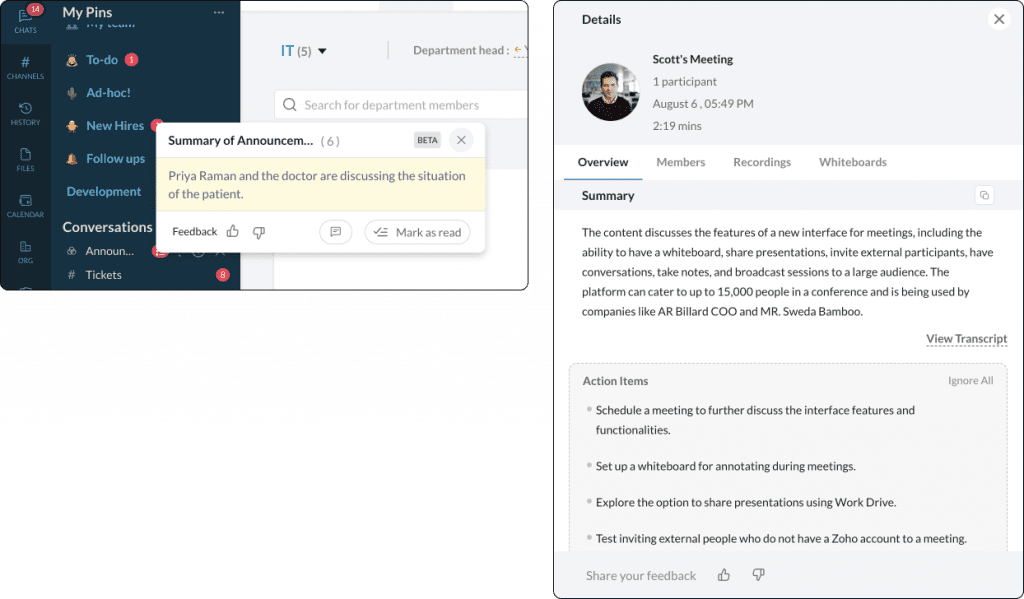
    Have you ever opened a group chat after several hours to find a flood of messages? With Zoho Cliq, you no longer need to read everything. Its automatic summary feature condenses lengthy conversations into key points, helping you quickly get back on track. This also applies to meetings, where AI summaries provide a precise breakdown of what was discussed.
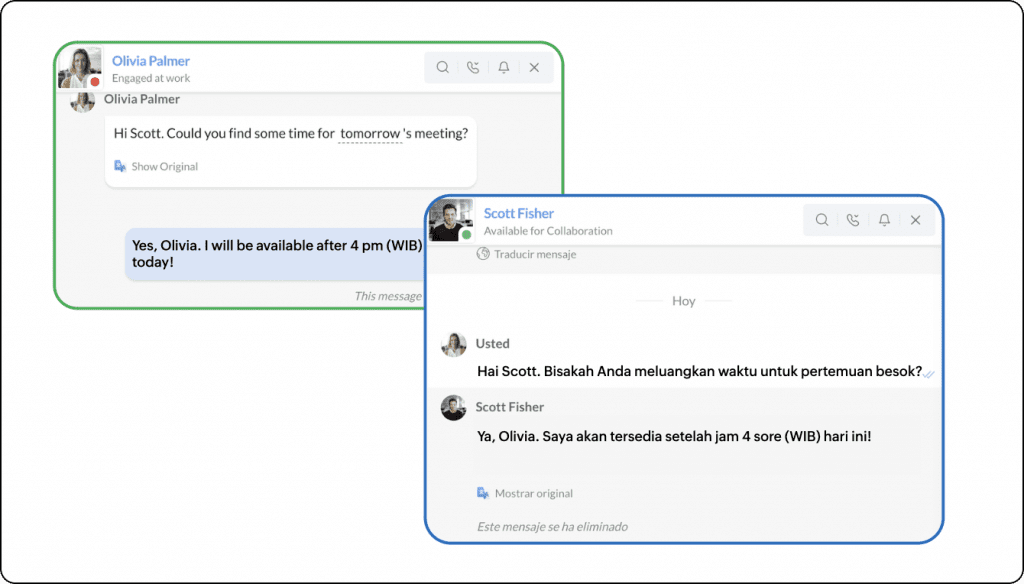
    Real-Time Translation: Goodbye Language Barriers
    Globalization connects us with teams and clients from different countries. Zoho Cliq integrates ZIA, its artificial intelligence, to translate messages into the language you need in seconds. This feature not only saves time but also prevents misunderstandings caused by language barriers.

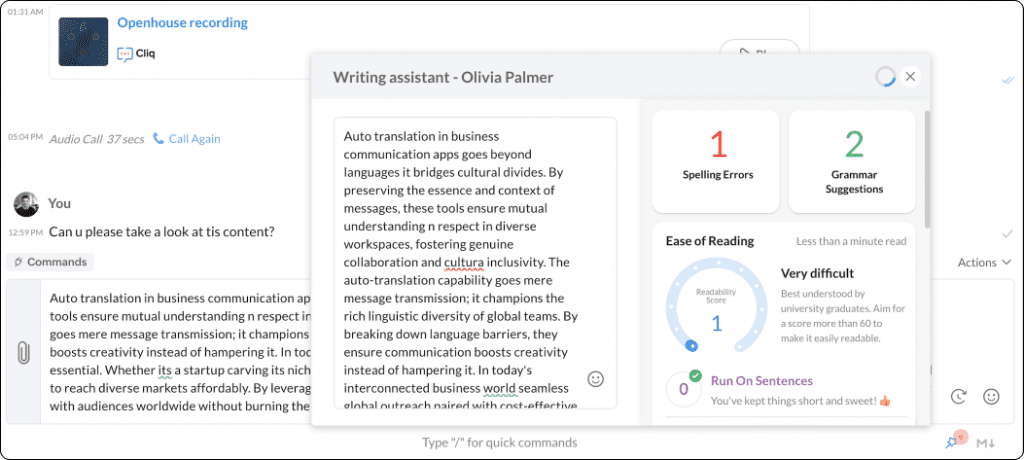
    Writing Assistant: Clear and Effective Messages
    Clarity in communication is key. Cliq’s writing assistant not only corrects grammatical errors but also suggests adjustments to ensure your message’s tone is professional and appropriate for the context. It’s like having a personal editor in your pocket.
    Boost Your Workflow with ChatGPT
    Zoho Cliq integrates with ChatGPT to offer advanced solutions, such as generating ideas, answering technical questions, summarizing conversations, or even designing simple images. This integration takes daily productivity to a whole new level, automating tasks that previously required more time and effort.
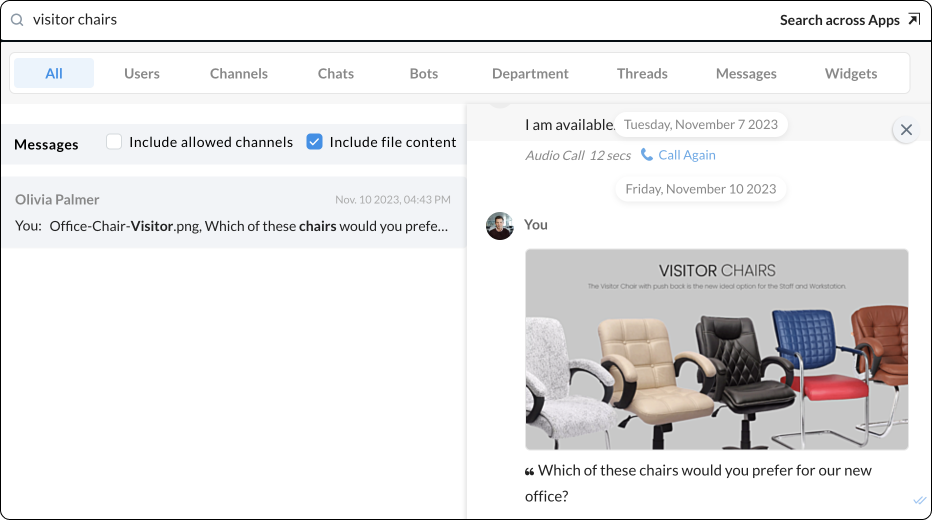
    Smart Searches with OCR
    Searching for important information among messages or documents can be tedious. The search function based on optical character recognition (OCR) allows you to locate files, images, or relevant messages by simply entering a keyword. This makes accessing critical information faster and more efficient.

    Channel Recommendations: Connection and Context
    Zoho Cliq learns from your activity to suggest channels that might interest you based on your interactions and preferences. This way, you never miss conversations or topics relevant to your work.


    Automation with Custom Bots
    Thanks to Cliq’s development platform, you can design bots tailored to your business’s specific needs. From automatic reminders to data collection, custom bots eliminate repetitive tasks and allow teams to focus on what matters.


    Contextual Reminders: Never Forget What’s Important
    When Cliq detects dates, times, or commitments in your messages, you can turn them into reminders with just a couple of clicks. This feature ensures you always stay on top of your tasks and events.


    Transforming the Way We Work with Zoho Cliq
    At InterConnecta, we don’t just implement technological tools; we help companies get the most out of them. Zoho Cliq, with its AI-driven innovations, is a clear example of how technology can eliminate distractions and enhance collaborative work.


    If you’re looking to take your team’s productivity to the next level, contact us. Our team of experts is ready to help you integrate Zoho Cliq and make the most of its features. Working better doesn’t have to be complicated, and with the right tools, the change starts today.
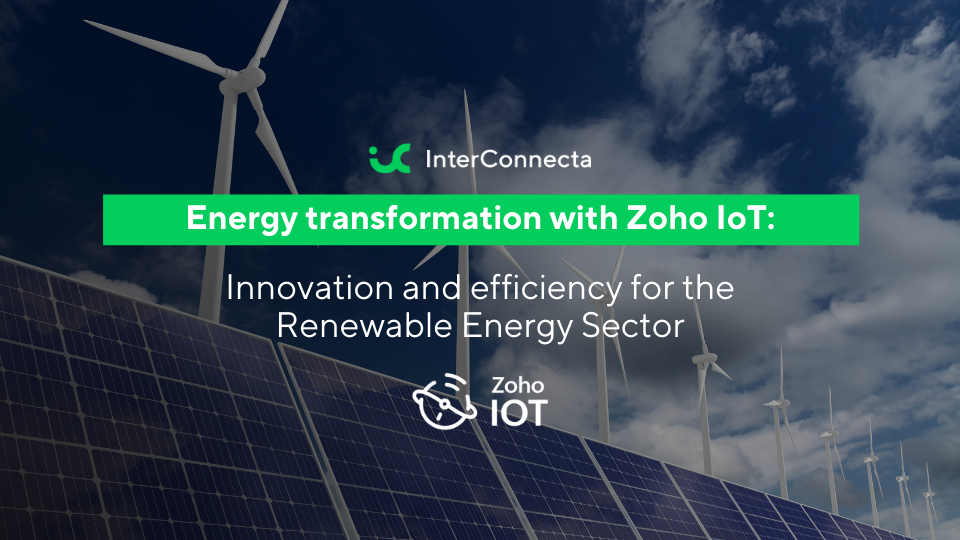

  • Energy transformation with Zoho IoT: Innovation and efficiency for the Renewable Energy Sector

    Today, technology and innovation are redefining processes in the renewable energy industry with the goal of creating a more sustainable future. One of the main challenges that companies in this sector face is how to efficiently manage their energy resources in real time without sacrificing productivity or increasing costs. Zoho, a leading technology solutions company, has launched its Zoho IoT platform to address this need.


    This service allows organizations to leverage the power of the Internet of Things (IoT) to intelligently and automatically manage and optimize a variety of systems, from energy production to distribution.


    IoT has become a fundamental ally in the digital transformation of companies. It enables the interconnection of devices, sensors, and systems to collect real-time data. This, in turn, enables predictive analysis, resource optimization, and better decision-making. The Zoho IoT platform stands out for its flexibility and adaptability to different industries and has been designed to address specific challenges.


    One of the most innovative modules of Zoho IoT is the Energy Management Service (EMS), which is optimized for companies in the renewable energy sector. Below, we will explore the key functionalities of this service and how it can benefit organizations seeking to improve energy efficiency and reduce their environmental footprint.

    What is Zoho IoT’s Energy Management Service?

    Zoho IoT’s Energy Management Service (EMS) is an advanced tool that helps companies monitor, analyze, and optimize their energy consumption. In a context where energy resources are increasingly costly and sustainability is a priority, EMS allows companies to efficiently manage their resources, reduce waste, and optimize energy performance.


    According to a study by McKinsey & Company, the potential energy savings through IoT technologies in energy companies can reach between 20% and 30%, representing a significant opportunity for those looking to innovate in their energy operations.


    With Zoho IoT, companies can not only monitor energy usage in real time but also anticipate and solve problems before they become major obstacles. This ability to make proactive rather than reactive adjustments is essential in a sector like renewable energy, which constantly faces shifts in demand and variations in energy generation. Executives in this sector, therefore, find in Zoho’s EMS an ally for making informed decisions based on accurate, real-time data, thereby improving operational resilience and increasing profitability.


    Key Functions of Zoho IoT’s Energy Management Service

    Real-Time Monitoring

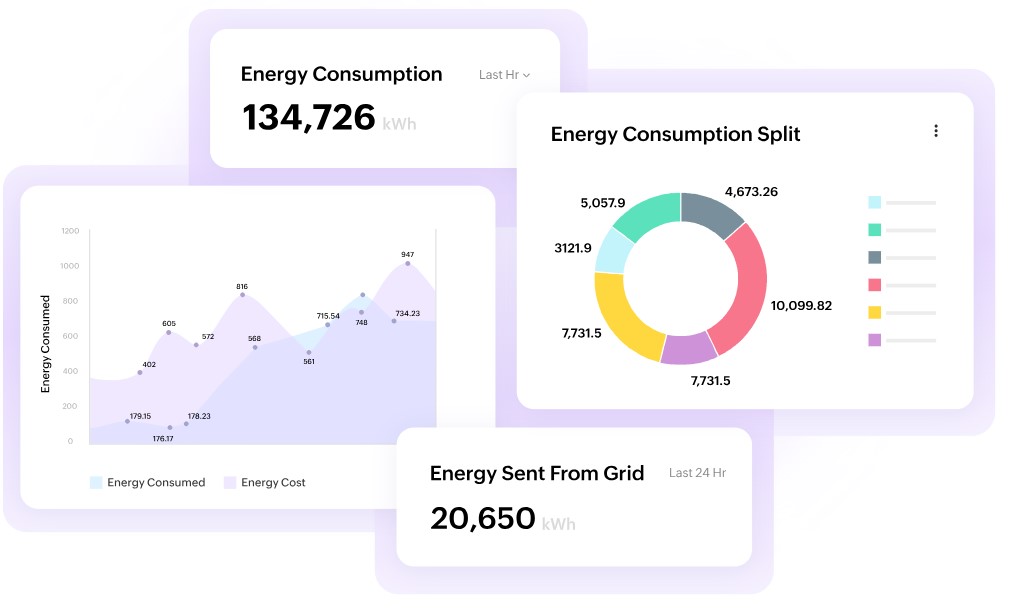
    Zoho IoT’s EMS allows real-time monitoring of energy flows at every stage of the process. This is essential to detect anomalous consumption patterns, identify inefficiencies, and make real-time adjustments. This monitoring enables energy managers to obtain a clear and precise view of the status of each component, whether a turbine, a solar panel, or a storage battery.

    With this continuous monitoring capability, the EMS not only reports on current energy use but also helps identify peak demand times, facilitating the implementation of strategies to reduce peak consumption.

    Energy Optimization

    One of the main benefits of Zoho’s EMS is its ability to analyze energy data and suggest improvements to optimize energy use. By accessing this data in real time, energy managers can reduce waste and improve operational efficiency. This energy optimization translates into a direct reduction in operating costs while contributing to meeting sustainability goals.
    According to a report by the International Energy Agency (IEA), improvements in energy efficiency could reduce global carbon emissions by up to 40% by 2040. These improvements are especially relevant for companies that, in addition to being efficient, aim to comply with increasingly strict sustainability standards.

    Smart Alerts and Preventive Maintenance

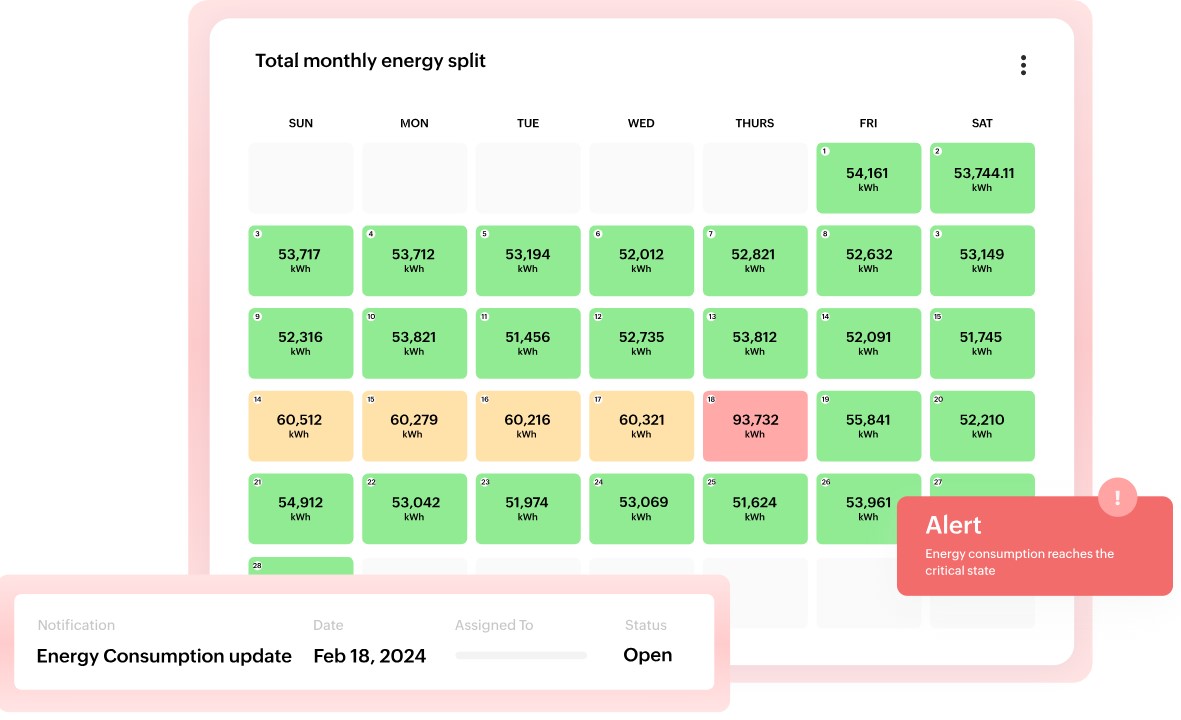
    Zoho IoT’s EMS incorporates a smart alert system that notifies operators of any anomaly in energy consumption or potential equipment failures. Thanks to this system, companies can adopt a preventive maintenance approach, identifying and solving issues before they affect production or increase costs.
    Failure prevention is particularly important in the renewable energy sector, where an interruption can lead to significant economic losses. Smart alerts also allow maintenance to be coordinated during periods of low energy demand, reducing downtime and improving overall system efficiency.

    Compliance with International Standards

    As environmental regulations become stricter, it is vital for renewable energy companies to comply with international standards of efficiency and sustainability. Zoho IoT’s EMS facilitates this compliance by providing detailed reports on energy usage, simplifying auditing and certification according to standards like ISO 50001. This standard is widely recognized and requires companies to establish systems and processes to improve energy efficiency, which not only optimizes resources but also builds trust among investors and customers.

    Carbon Footprint Management

    Reducing the carbon footprint is a priority in the renewable energy industry, and Zoho IoT’s EMS enables detailed tracking of carbon emissions. By analyzing energy data, companies can identify areas that generate higher emissions and develop effective strategies to mitigate them. This not only contributes to the environment but also enhances the company’s reputation in the market.

    The renewable energy sector is at a critical point where efficiency, sustainability, and regulatory compliance are key to success. The Zoho IoT platform and specifically, the Energy Management Service, provide companies with the necessary tools to meet these challenges. With functionalities such as real-time monitoring, energy optimization, smart alerts, and carbon footprint management, Zoho IoT positions itself as an essential ally for companies looking to lead the shift towards a greener energy future.


    To learn more about how Zoho IoT can transform your business’s energy management, visit the official Zoho IoT page on energy management.

    Are you interested in optimizing your renewable energy business?
    Fill out our form, and one of our specialists will contact you to explore how Zoho IoT can boost efficiency in your operations.


    Conctact us

  • Zoho Analytics 6.0: The Future of Data Analysis with AI

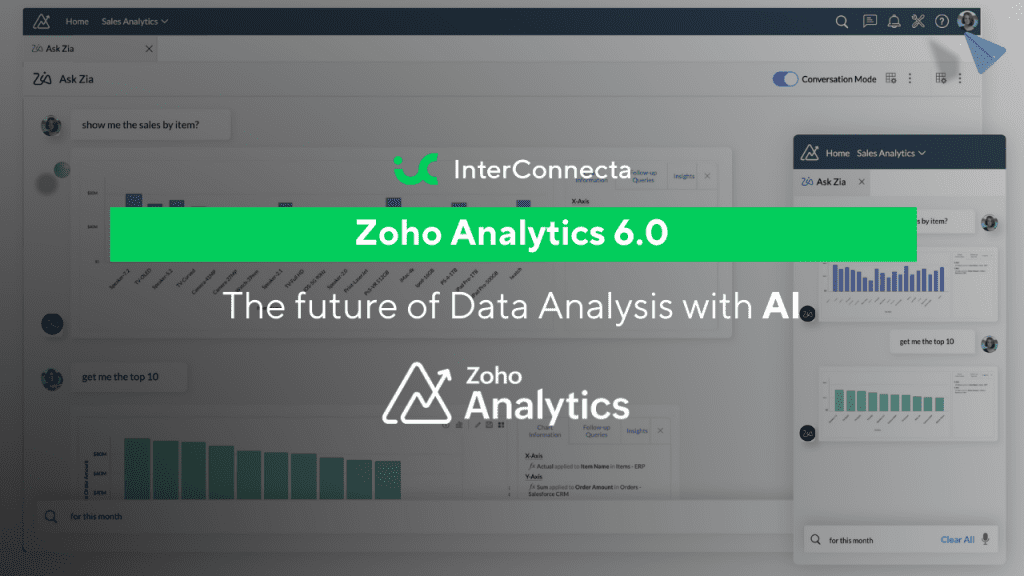
    Zoho Analytics has launched its 6.0 version, incorporating significant advancements in Artificial Intelligence (AI) that will transform how companies analyze and understand their data. With new generative AI functions and predictive models, this update enhances the ability to make informed decisions quickly. But why is AI so relevant in this evolution?

    Data analysis has become a challenge for companies struggling to extract value from the volume and complexity of the information they handle. Extracting useful insights from massive volumes of data in a timely manner is a challenge. Traditional tools require too much time and advanced technical skills, delaying strategic decisions.


    Zoho Analytics version 6.0 introduces several AI-driven features that make data analysis more intuitive and powerful.


    Here are the most important highlights:

    • Enhanced Ask Zia: Zia is the AI-based conversational assistant that allows users to ask questions about their data in natural language and receive immediate answers in the form of reports or graphs. In this version, Ask Zia has improved its understanding capabilities and is now available on external platforms like Microsoft Teams, facilitating team collaboration.
    • Expanded Zia Insights: In addition to offering automated data summaries, Zia can now create visual narratives explaining significant trends or changes. This ability turns raw data into comprehensible stories, helping users identify patterns or anomalies without having to interpret complex charts.
    • Predictive models and time series: The new predictive analysis capability allows for forecasting future outcomes based on historical data. Companies can create time series models that help predict fluctuations in sales, demand, or key metrics. Additionally, the system can detect anomalies in the data, automatically alerting about unusual events that may require attention.
    • Automation with AutoML: One of the most innovative features of this update is the inclusion of AutoML (Automated Machine Learning), which allows users to build predictive models without needing programming or data science knowledge. This democratizes access to advanced analytics and helps non-technical teams leverage machine learning to make informed decisions.
    • Multisource integration and data enrichment: The platform expands its ability to integrate data from multiple sources, both internal and external applications, and offers more accurate analytics. Zoho Analytics 6.0 also includes enhancements in data processing, allowing for automatic data enrichment, which helps improve insight quality without manual intervention.


    Zoho Analytics 6.0 brings Artificial Intelligence to the heart of data analysis, offering intuitive tools that enable any company to enhance its decision-making process. With features ranging from predictive analytics to automation, this platform helps businesses navigate data complexity more efficiently.


    If you’re ready to transform your approach to data analysis, we invite you to try the free version of Zoho Analytics or speak with one of our experts. Discover how AI can boost your business decisions!

  • Agile support and happy customers with the power of AI in Zoho Desk

    Nowadays, customers demand quick and personalized responses, which presents challenges when the volume of inquiries increases and issues become more complex. Many companies face difficulties with prolonged response times, overburdened agents, and a lack of personalization in interactions, which affects service quality and customer satisfaction.


    According to a recent report by Gartner, 60% of customer service leaders will apply generative AI technologies to improve customer experience by 2025. This adoption will not only reduce costs but also allow companies to anticipate issues and improve service through greater automation and AI-optimized human assistance. (Source: Customer Service Leadership Predictions in 2024, Gartner)


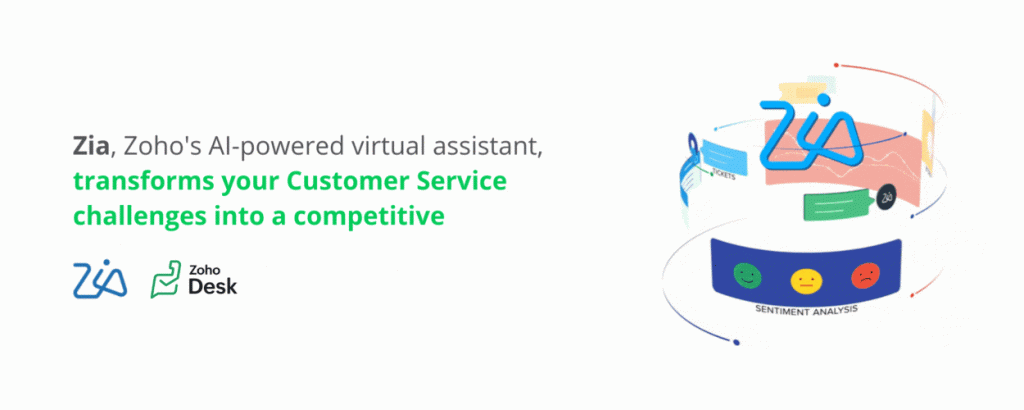
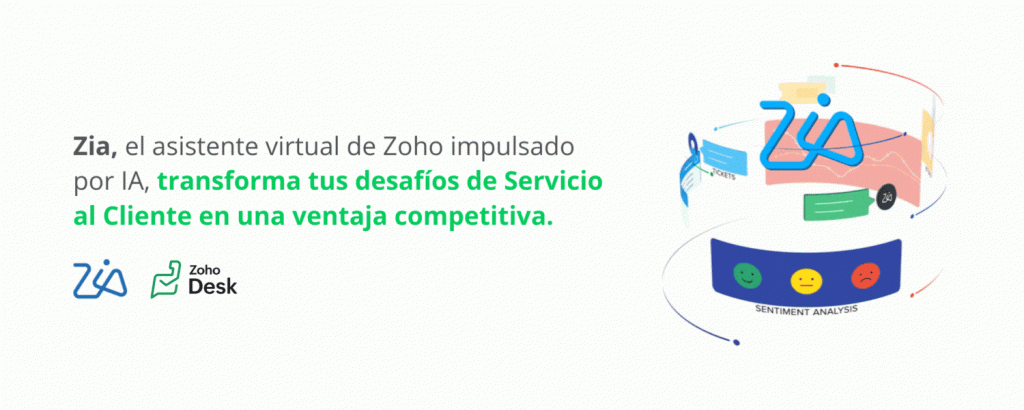
    This is where Zoho Desk’s Artificial Intelligence comes into play, designed to enhance every aspect of customer service, from automatic ticket classification to generating data-driven responses. With Zia, Zoho’s AI-powered virtual assistant, you can turn these challenges into a competitive advantage.

    Customer Service as a Competitive Advantage

    Excellent customer service is no longer just a differentiator, but a necessity to remain competitive. By automating routine tasks and providing faster, more accurate responses, AI not only optimizes agents’ workloads but also improves the customer experience. When customers receive efficient and personalized attention, they are not only more likely to be satisfied but also to become loyal advocates for your brand.


    AI Solutions with Zia in Zoho Desk


    1. Sentiment Analysis

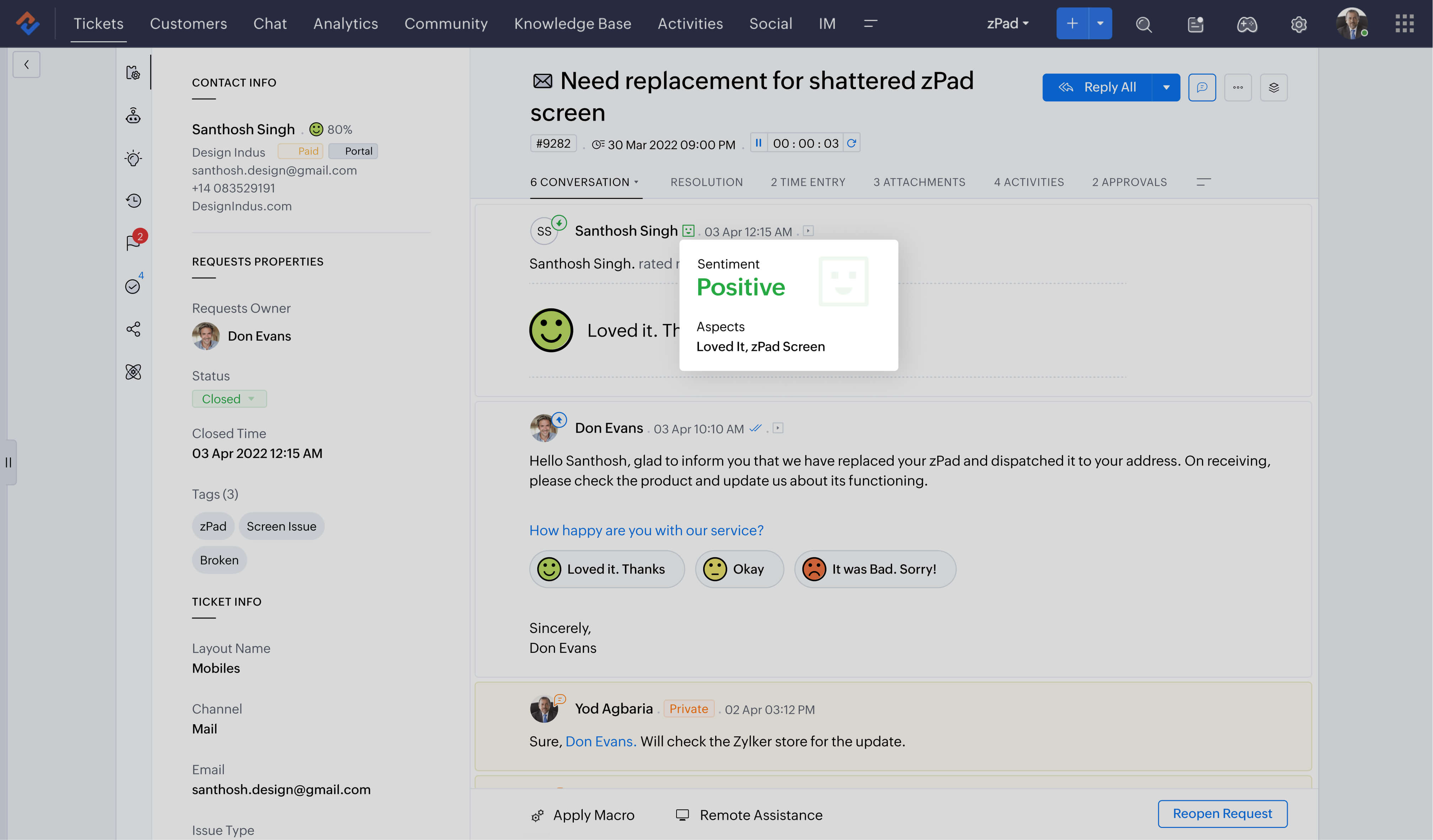
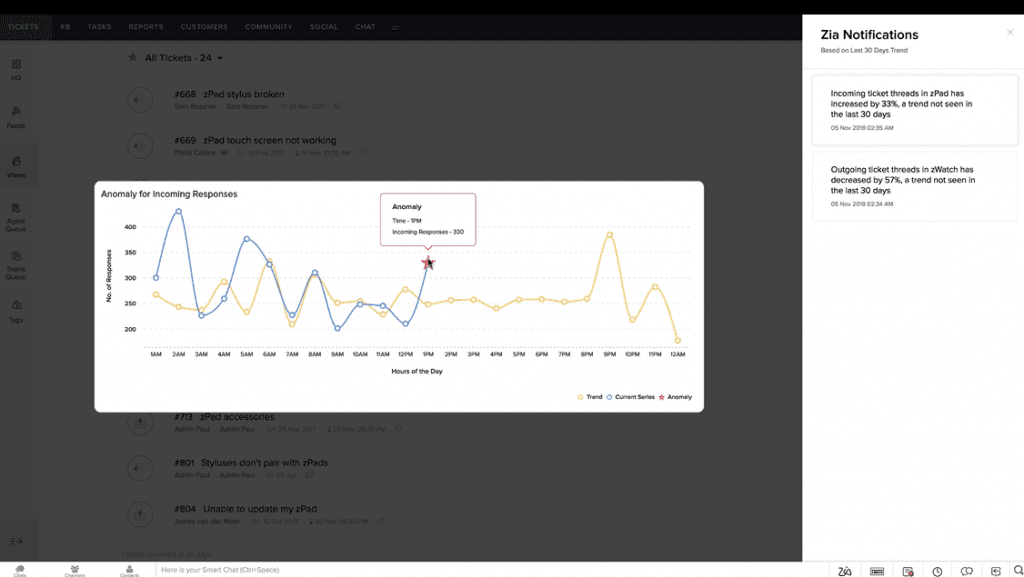
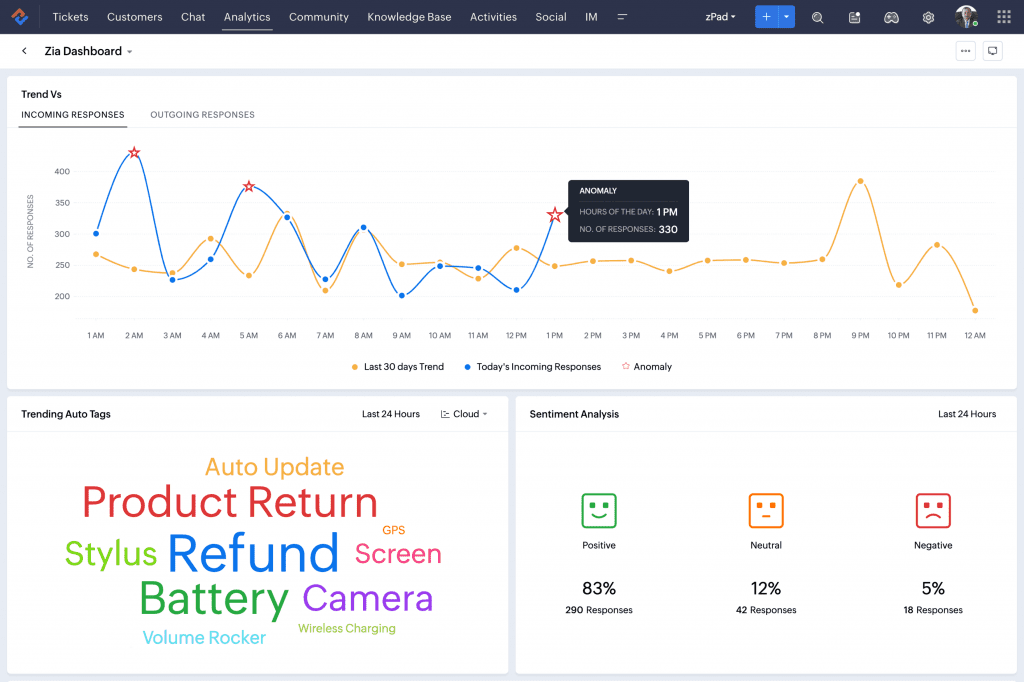
    Zia analyzes the tone of each incoming message, helping agents understand the emotional state of customers before responding. This allows them to adjust the tone of their replies based on the situation, which can be key to defusing tense interactions or improving deteriorating relationships. The ability to identify whether a conversation is getting worse or improving can make the difference between losing or retaining a customer.

    ZIA - Zia puede identificar el sentimiento

    (image vía zoho)


    2. Automatic Ticket Classification

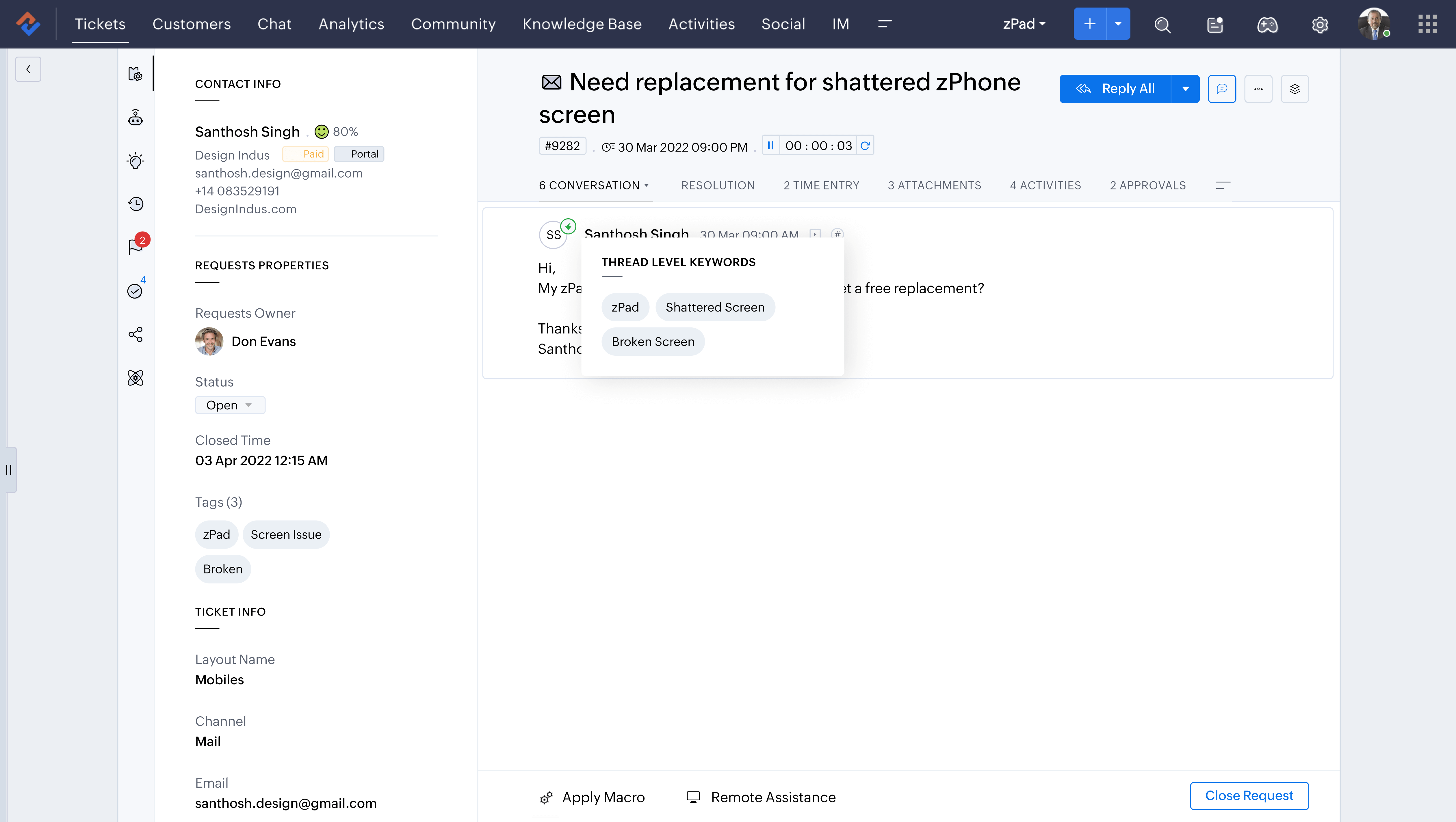
    Instead of agents having to manually read and classify each ticket, Zia automatically identifies keywords and assigns tags, organizing tickets efficiently. This makes it easier for agents to prioritize their work and for managers to have a clear view of the topics that concern customers the most.

    autotags

    (image vía zoho)


    3. Smart Response Assistant

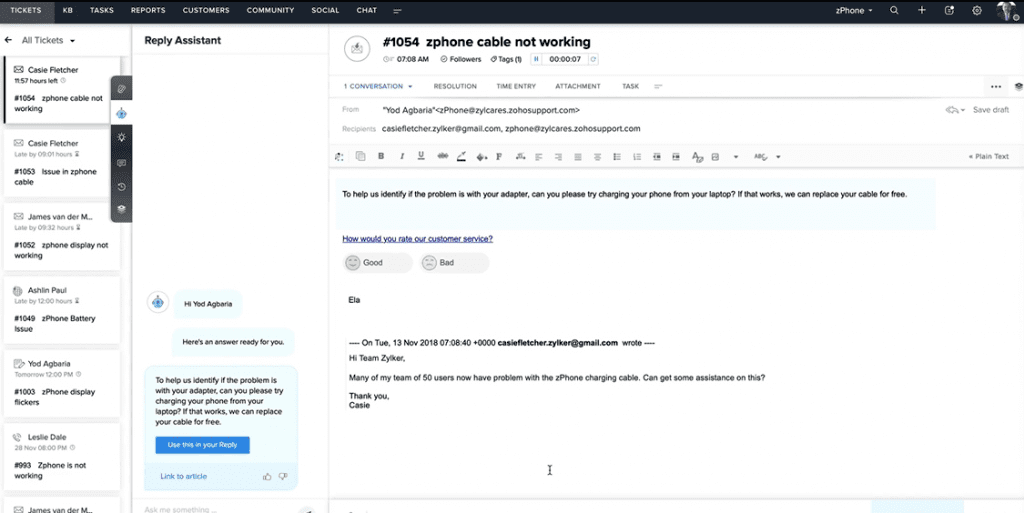
    With the assisted response feature, Zia suggests replies based on ticket history and knowledge base articles. This means agents can resolve issues faster without having to manually research each case. They can even chat with Zia for clarifications on specific policies or conditions, eliminating the need for lengthy internal discussions.


    (image vía zoho)


    4. Automatic Summary Generation

    Zia also provides automatic ticket summaries that allow agents to quickly view the key points of conversations, helping them make more informed decisions without having to read through the entire message history.

    (image vía zoho)


    5. Predictions

    Zia’s AI not only reacts but also predicts potential problems. By monitoring interaction patterns and analyzing large amounts of historical data, Zia can foresee potential service issues and suggest actions before problems escalate.

    (image vía zoho)


    Ready to Put AI to Work for You?

    With Zoho Desk and Zia’s advanced AI capabilities, you can offer faster, more efficient, and personalized service to your customers. Don’t miss the opportunity to experience how artificial intelligence can revolutionize your business.


    Start your free trial of Zoho Desk today and discover the future of customer service. Start making a difference!

    Hoy en día, los clientes demandan respuestas rápidas y personalizadas, lo que presenta desafíos cuando el volumen de consultas aumenta y los problemas se vuelven más complejos. Muchas empresas enfrentan dificultades con tiempos de respuesta prolongados, agentes sobrecargados y una falta de personalización en las interacciones, lo que afecta la calidad del servicio y la satisfacción del cliente.


    Según un informe reciente de Gartner, el 60% de los líderes de servicio al cliente aplicarán tecnologías de IA generativa para mejorar la experiencia del cliente para 2025. Esta adopción no solo reducirá costos, sino que también permitirá anticipar problemas y mejorar el servicio mediante una mayor automatización y asistencia humana optimizada por IA. (Fuente: Customer Service Leadership Predictions in 2024, Gartner).


    Aquí es donde entra en juego la Inteligencia Artificial de Zoho Desk, diseñada para mejorar cada aspecto del servicio al cliente, desde la clasificación automática de tickets hasta la generación de respuestas basadas en datos. Con Zia, el asistente virtual de Zoho impulsado por IA, puedes transformar estos desafíos en una ventaja competitiva.

    Un Servicio al Cliente como ventaja competitiva

    Un excelente servicio al cliente ya no es solo un diferenciador, sino una necesidad para mantenerse competitivo. Al automatizar tareas rutinarias y ofrecer respuestas más rápidas y precisas, la IA no solo optimiza la carga de trabajo de los agentes, sino que también mejora la experiencia del cliente. Cuando los clientes reciben atención eficiente y personalizada, no solo es más probable que queden satisfechos, sino que se convierten en defensores leales de tu marca.


    Soluciones de IA con Zia en Zoho Desk

    1. Análisis de sentimientos 

    Zia analiza el tono de cada mensaje que llega, ayudando a los agentes a entender el estado emocional de los clientes antes de responder. Esto permite ajustar el tono de las respuestas según la situación, lo que puede ser clave para desactivar interacciones tensas o mejorar relaciones deterioradas. La capacidad de identificar si una conversación está empeorando o mejorando puede marcar la diferencia entre perder un cliente o retenerlo.

    ZIA - Zia puede identificar el sentimiento

    (imagen vía zoho)


    2. Clasificación automática de Tickets
    En lugar de que los agentes tengan que leer y clasificar manualmente cada ticket, Zia automáticamente identifica palabras clave y asigna etiquetas, organizando los tickets de manera eficiente. Esto facilita que los agentes prioricen su trabajo y que los gerentes tengan una visión clara de los temas que más preocupan a los clientes.

    autotags

    (imagen vía zoho)


    3. Asistente de respuestas inteligentes
    Con la función de respuesta asistida, Zia sugiere respuestas basadas en el historial de tickets y los artículos de la base de conocimiento. Esto significa que los agentes pueden resolver problemas más rápido sin tener que investigar manualmente cada caso. Incluso pueden chatear con Zia para obtener aclaraciones sobre políticas o condiciones específicas, lo que elimina la necesidad de largas discusiones internas.


    (video vía zoho)


    4. Generación automática de resúmenes
    Zia también ofrece resúmenes automáticos de tickets que permiten a los agentes ver de un vistazo los puntos clave de las conversaciones, ayudándolos a tomar decisiones más informadas sin tener que leer todo el historial de mensajes.

    (video vía zoho)


    5. Predicciones 
    La IA de Zia no solo reacciona, sino que también predice posibles problemas. Al monitorear patrones de interacción y analizar grandes cantidades de datos históricos, Zia puede predecir posibles problemas en el servicio y sugerir acciones antes de que los problemas se escalen.

    (imagen vía zoho)


    Listo para hacer que la IA trabaje por tí?

    Con Zoho Desk y las capacidades avanzadas de IA de Zia, podrás ofrecer un servicio a tus clientes más rápido, eficiente y personalizado. No pierdas la oportunidad de experimentar cómo la inteligencia artificial puede revolucionar tu negocio.

    Inicia hoy tu prueba gratuita de Zoho Desk y descubre el futuro de la atención al cliente. ¡Empieza a marcar la diferencia!

  • Enhance Your Project Management with Zia, Zoho’s AI

    With advanced artificial intelligence integration, Zoho once again demonstrates its industry leadership by offering tools that not only simplify task management but also boost your entire team’s efficiency and productivity.

    That’s why we’re excited to share with you the features of Zia, the intelligent assistant in Zoho Projects, which is revolutionizing the way you handle your projects.


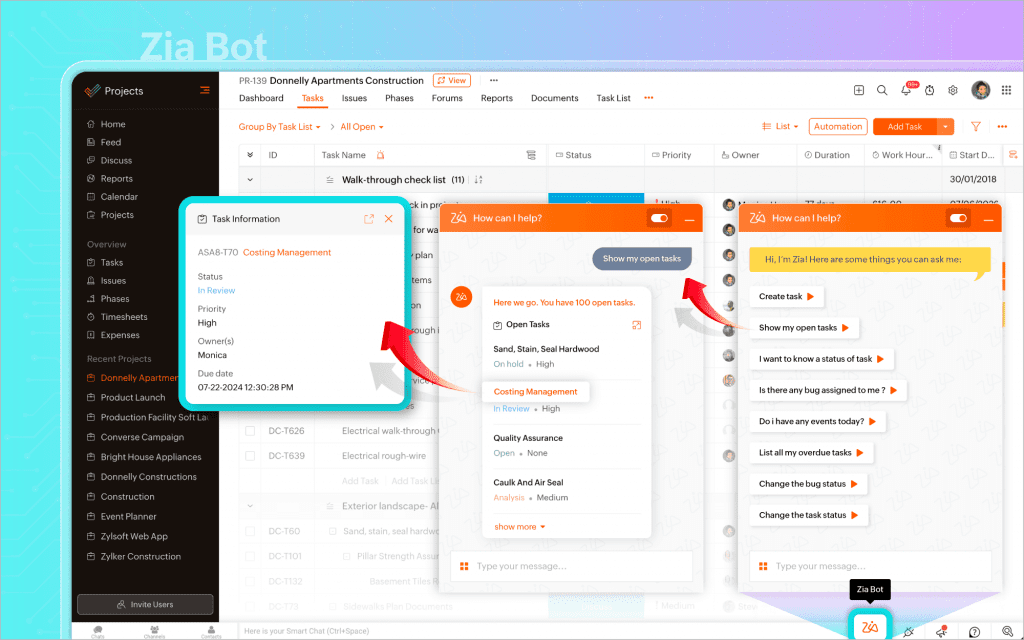
    Zia Bot: Your Ally for Hassle-Free Project

    Management Zia Bot is your personal assistant in Zoho Projects, designed to streamline every aspect of project management. Whether you need to create a new project, assign tasks, or simply update progress, Zia does it with natural language commands, eliminating the need to navigate complex menus. Imagine being able to check the status of a task or reassign resources with just a few words. This is Zia’s promise: efficiency and simplicity in every interaction.

    (image via zoho)


    Find What You Need with Zia Search

    Finding information has never been easier. With Zia Search, you can quickly access your project data using conversational language, as if you were talking to a colleague. This not only saves time but also allows you to focus on what really matters: driving your projects to success without distractions.


    Make Informed Decisions with Zia Insights

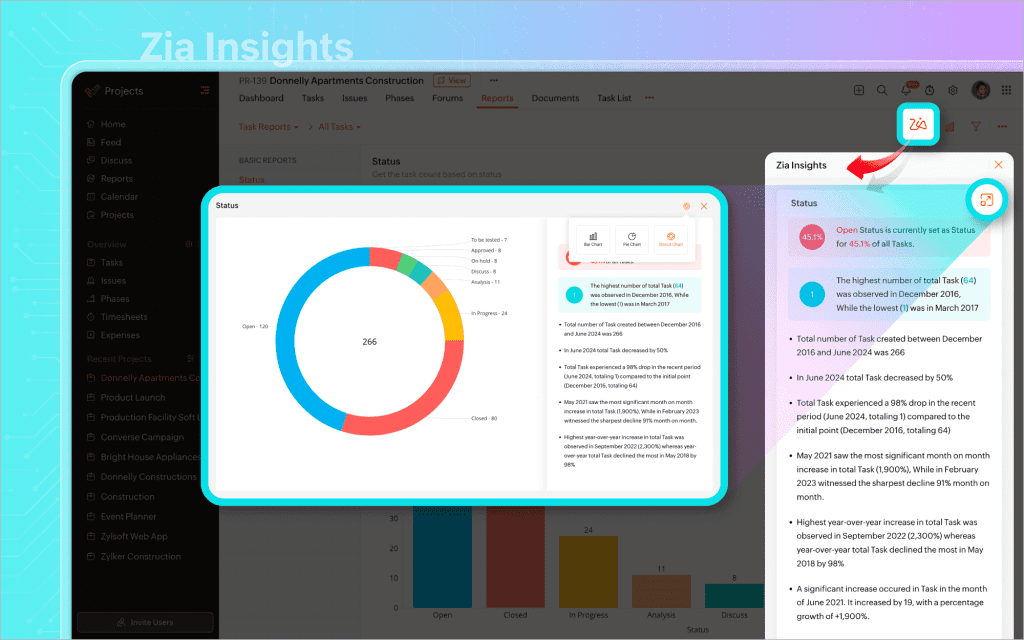
    With Zia Insights, you have in-depth and detailed analysis of your projects at your fingertips. This tool uses AI to interpret complex data and turn it into useful information that you can use to optimize resources, identify bottlenecks, and improve efficiency. Data-driven decision-making has never been so accessible.

    (image vía zoho)


    Global Collaboration with Zia Translate

    Effective communication is key in any project, especially in global teams. With Zia Translate, language barriers disappear. This tool allows for automatic translation of over 70 languages, ensuring that all your team members are aligned, no matter their native language.


    Unlock New Possibilities with Generative AI in Zoho Projects

    Zoho Projects now includes generative AI capabilities powered by ChatGPT. This integration allows you to create and refine content directly on the platform, from project descriptions to summaries, optimizing your management processes. Activating this feature is simple and opens up a world of possibilities for improving the clarity, tone, and accuracy of your communication.


    With these advanced features, Zoho Projects not only simplifies daily management but also empowers you to reach new levels of success. At InterConnecta, we invite you to embrace these innovations and transform the way you manage your projects. The future of project management is now, and with Zia and Zoho, the possibilities are limitless.


    Ready to experience these cutting-edge tools? Try Zoho Projects for free and discover how it can revolutionize your team’s productivity. And if you need personalized advice or help getting started, don’t hesitate to contact us. We’re here to support you every step of the way.

  • The Urgency of Modernizing Legacy Systems: How Zoho and AI Can Save Companies from Obsolescence

    The need to modernize Legacy Systems in companies is more urgent than ever. Businesses looking to stay competitive must ensure that their technological infrastructure is up to new challenges and leverages the most advanced technologies. At InterConnecta, we understand the complexities of this process and offer tailored solutions to help companies transform their outdated systems into agile, efficient, and future-ready operations.

    Why Modernize Legacy Applications?

    A legacy system is outdated technology that remains essential to a company’s daily operations but can no longer easily adapt to new needs or integrate with modern technologies. While often reliable, they can become a barrier to innovation. They lack the flexibility, scalability, and integration capacity that companies need today. Additionally, maintaining and updating these systems can be costly and time-consuming.
    Using AI to Evaluate Legacy Systems

    The first step in modernizing legacy systems is to conduct a thorough analysis using advanced AI tools. This analysis helps us identify performance issues, integration challenges, and potential security risks, allowing for the development of a strategic roadmap for modernization.

    Zoho: Key Tools for Successful Modernization

    Zoho applications are essential for bridging the gap between legacy systems and current business needs. With Zoho, we can integrate new tools with existing systems, improving functionality and efficiency. Here are some of the solutions offered:

    creator.svg

    • Zoho Creator: Allows for the rapid and easy development of custom applications. Integrating it with legacy systems adds new functions without major coding efforts, ensuring a smooth transition.

    crm.svg

    • Zoho CRM: Zoho CRM provides robust features for managing customer data, automating sales processes, and enhancing customer engagement. Integrating Zoho CRM with legacy databases ensures a unified view of customer interactions.

    analytics.svg

    • Zoho Analytics: Data-driven decision-making is essential. Zoho Analytics extracts valuable insights from your legacy data, facilitating strategic planning and improving operational efficiency.

    Flow-logo-lockup

    • Zoho Flow: This integration platform as a service (iPaaS) tool allows businesses to automate workflows and integrate various applications. By using Zoho Flow, companies can create seamless workflows between legacy systems and modern applications, enhancing overall productivity.

    Modernizing with Zoho not only improves functionality but also significantly reduces costs. Zoho’s cloud solutions eliminate the need for expensive on-premises infrastructure and maintenance. Additionally, its automation capabilities optimize operations, reducing manual intervention and minimizing errors.

    In conclusion, transforming legacy systems into modern applications is a complex but essential challenge to remain competitive in today’s environment. With the right tools and expertise, this process can be smooth and extremely beneficial.

    InterConnecta: Your Strategic Partner in Technological Modernization

    At InterConnecta, we combine our expertise in Zoho implementation with our advanced AI capabilities to effectively modernize your legacy systems. We work closely with our clients to develop a tailored strategy, ensuring a smooth transition to more agile and future-ready operations.

    Let us help you unlock the full potential of your technological infrastructure and pave the way to a more efficient and competitive future. Contact us today!

  • Exploring the Future of AI Infrastructure: Vector Databases vs. Lakehouse Architecture

    In the ever-evolving landscape of artificial intelligence (AI), selecting the optimal data architecture is crucial for organizations aiming to harness the full potential of their AI initiatives. At Interconnecta, we are committed to pioneering innovative solutions that empower midsized and enterprise-level organizations to thrive in this dynamic environment. To this end, we have been meticulously researching and comparing two prominent architectures: vector databases and lakehouse architecture. Our goal is to identify the best practices and industry needs that will guide us in integrating Zoho’s capabilities into these frameworks.


    Vector Databases: Precision and Performance

    Vector databases are designed to handle high-dimensional data efficiently, making them a prime candidate for AI applications that require rapid retrieval and processing of large datasets. These databases use vectors to represent data points, which allows for faster similarity searches and machine learning model training.

    Key Benefits of Vector Databases:

    1. Speed and Efficiency: Vector databases excel in delivering high-speed query responses, which is essential for real-time AI applications.
    2. Scalability: They offer robust scalability, accommodating the growing data needs of enterprises without compromising performance.
    3. Enhanced Accuracy: By leveraging advanced indexing techniques, vector databases can improve the accuracy of AI models, particularly in tasks like image recognition and natural language processing.

    However, implementing a vector database architecture requires a significant upfront investment in specialized infrastructure and expertise. Organizations must evaluate whether the performance gains justify these costs.


    Lakehouse Architecture: Flexibility and Integration

    Lakehouse architecture represents a hybrid approach that combines the best features of data lakes and data warehouses. This architecture allows organizations to store vast amounts of raw data in a cost-effective manner while providing structured access for analytics and AI.

    Key Benefits of Lakehouse Architecture:

    1. Unified Data Platform: Lakehouse architecture offers a single platform for all data types, facilitating easier data management and integration.
    2. Cost-Effectiveness: It reduces the need for multiple data silos and can be more cost-effective in terms of storage and maintenance.
    3. Versatility: By supporting both batch and real-time data processing, lakehouse architecture is versatile enough to handle a wide range of AI and analytics use cases.

    Despite its advantages, the lakehouse model can introduce complexity in data governance and quality control. Organizations need to ensure robust policies and practices are in place to maintain data integrity and compliance.


    Integrating Zoho into AI Architectures

    Zoho’s suite of tools can play a pivotal role in enhancing both vector database and lakehouse architectures. For midsized and enterprise-level organizations, Zoho offers a range of solutions that can streamline data management, analytics, and AI deployment.

    Zoho’s Role in Vector Database Architecture

    This tool can integrate seamlessly with vector databases, providing powerful analytics capabilities and real-time insights.

    Creator-logotype

    With its low-code platform, organizations can develop custom AI applications that leverage the speed and precision of vector databases.

    2

    Zoho’s AI capabilities can be embedded into existing workflows, enhancing decision-making and operational efficiency.

    Zoho’s Role in Lakehouse Architecture:

    This tool helps organizations clean, transform, and prepare data for analysis, ensuring high data quality in the lakehouse.

    It enables seamless data integration across various platforms, facilitating smooth data movement within the lakehouse architecture.

    This solution allows organizations to harness the power of big data analytics, driving deeper insights and more informed decision-making.

    Conclusion: Charting a Path Forward

    As we continue to explore the nuances of vector databases and lakehouse architecture, our focus remains on identifying the optimal solutions that align with industry needs and best practices. At Interconnecta, we are committed to leveraging Zoho’s versatile suite of tools to empower organizations in their AI journey. By providing scalable, efficient, and cost-effective AI infrastructure, we aim to drive innovation and operational excellence for midsized and enterprise-level businesses.

    Our research is ongoing, and we invite our partners and clients to join us in this exploration. Together, we can navigate the complexities of AI infrastructure and unlock new opportunities for growth and success.

    By embracing the right architecture and leveraging Zoho’s capabilities, Interconnecta is poised to lead the way in delivering cutting-edge AI solutions. Our commitment to excellence and innovation ensures that our clients remain at the forefront of technological advancements, equipped to meet the demands of an increasingly AI-driven world.

    Contact us to discover how AI infrastructure can transform your business. Our team of experts is ready to help you implement innovative solutions that will drive your growth.


  • Empower your business with Zoho CRM and AI Technology

    Have you wondered how you can optimize customer relationship management? Or how to anticipate their needs to offer exceptional service? Integrating Zoho CRM with Artificial Intelligence (AI) features offers a wide range of benefits that can transform customer relationship management and optimize various business operations. Below, we explore how these AI features can maximize your business potential.


    • Customer Behavior Predictions
      Zoho CRM uses predictive analytics to anticipate customer behavior. This allows businesses to foresee customer needs and behaviors, improving personalization and customer satisfaction.
    • Automated Email Responses
      Natural language processing (NLP) automates email responses, streamlining communication and ensuring quick and accurate replies to customer inquiries.
    • Lead Scoring
      Using machine learning algorithms, Zoho CRM can assign scores to leads based on their likelihood of conversion, helping to prioritize efforts and resources efficiently.
    • Customer Support with Chatbots
      Integrated chatbots in Zoho CRM provide 24/7 customer support, answering common queries and resolving basic issues without human intervention.
    • Voice Notes and Commands
      Voice recognition allows users to dictate notes and commands, enhancing efficiency and facilitating information management on the go.
    • Business Card Scanning
      Image recognition technology allows business cards to be scanned and contact data automatically imported into the CRM, saving time and reducing errors.
    • Product Recommendations
      Recommendation engines suggest products based on purchase history and previous customer interactions, increasing cross-sell and up-sell opportunities.
    • Customer Feedback Analysis
      Sentiment analysis evaluates customer feedback, providing insights into their satisfaction levels and areas needing improvement.
    • Fraud Detection
      Anomaly detection helps identify and prevent fraudulent activities, protecting the business from potential losses and legal issues.
    • Task Automation
      Workflow automation reduces the time spent on repetitive tasks, allowing employees to focus on strategic and higher-value activities.
    • Dynamic Customer Segmentation
      Zoho CRM uses dynamic segmentation to group customers with similar characteristics, facilitating more effective and targeted marketing campaigns.
    • Churn Prediction
      Churn prediction identifies customers at risk of discontinuing services, enabling the implementation of proactive retention strategies.
    • Meeting Transcription
      Automatic meeting transcription captures and stores all relevant information, improving documentation and follow-up on agreements.
    • Sales Analysis
      Advanced analysis provides deep insights into sales performance, identifying trends and areas for improvement.
    • Business Insights
      AI-driven insights offer detailed analysis on business opportunities, helping to make informed and strategic decisions.


    Integrating Zoho CRM with these advanced AI features not only enhances operational efficiency but also drives growth and customer satisfaction. Are you ready to take your business to the next level? Entrepreneurs who leverage these technologies will be better positioned to lead in their respective markets. What are you waiting for to integrate AI into your CRM and transform the way you manage your customer relationships?

    Contact us today and discover how we can help you achieve success!

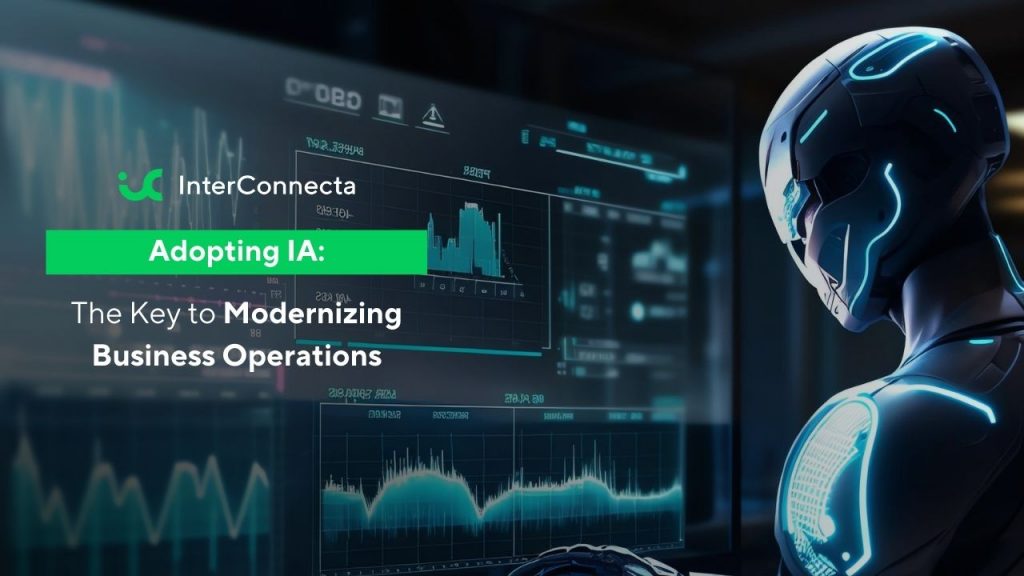
  • Adopting AI: The Key to Modernizing Business Operations

    Artificial Intelligence (AI) has become a strategic imperative for companies seeking not only to survive in the digital age but to thrive and lead the market. This revolutionary technology acts as a transformation engine, driving companies to develop a sustainable competitive advantage and redefine their business operations at all levels. The transition to AI-driven operations requires meticulous planning and strategic execution. Various recent studies and research in the field corroborate this, highlighting the importance of adopting a comprehensive and well-structured approach to fully harness AI’s potential.


    Breaking Data Silos: How Real-Time Data Sharing Boosts Efficiency and Decision-Making

    A significant challenge for contemporary companies is the persistence of fragmented data silos. Research indicates that organizations must establish robust systems to facilitate live data sharing across platforms. This approach not only breaks data barriers but also enhances real-time data transmission capabilities, ensuring that actionable insights are easily accessible to all employees.

    An example of this is a retail company implementing an AI-driven platform that integrates sales data from online and offline channels. This provides real-time inventory updates and customer insights, enabling store managers to make informed decisions about restocking and marketing strategies. This, in turn, improves operational efficiency and customer satisfaction.

    At InterConnecta, we leverage Zoho’s robust suite of tools to facilitate such integrations, ensuring seamless data flow and accessibility.


    Unified Data Governance: The Key to Unlocking AI’s Power in the Multicloud Era

    Achieving effective AI integration requires a unified approach to data and AI governance. Studies reveal that fragmented strategies in this area can hinder effective AI utilization. A cohesive governance framework is essential for securely managing data and AI assets, thus optimizing their use. This framework also enables organizations to scale their AI initiatives in complex multicloud environments, providing the necessary flexibility when working with multiple cloud providers.

    For example, a financial services firm could adopt a unified data governance strategy to ensure compliance with regulatory requirements while allowing seamless data sharing between different departments and cloud platforms. This approach not only enhances data security but also improves the accuracy and efficiency of AI-driven risk assessments and fraud detection.

    InterConnecta employs Zoho’s data management solutions to support these governance frameworks, ensuring data integrity and compliance.


    Tailored AI: Adapting to Each Industry’s Unique Needs

    Generative AI does not represent a one-size-fits-all solution. Each industry requires customized strategies to fully leverage AI’s potential. A personalized approach, as demonstrated by various analyses, is crucial to addressing the unique needs of each sector. Investing in building solid data and AI foundations is essential to driving long-term growth and innovation.

    For example, in the healthcare industry, AI can be used to analyze large amounts of patient data to identify patterns and predict disease outbreaks. Hospitals and clinics can implement AI systems that integrate electronic health records (EHR) with real-time patient monitoring data, enabling personalized treatment plans and early intervention. Such a personalized approach ensures that AI solutions align with the specific requirements and challenges of the healthcare sector.

    At InterConnecta, thanks to Zoho’s flexible architecture, we have been able to provide healthcare organizations with customized AI solutions that address their unique challenges.


    Data Architecture Modernization

    True organizational transformation is impossible to achieve with outdated technology. Data consolidation and system modernization are essential. Various studies emphasize the relevance of simplifying data management and enabling rapid and scalable deployment of AI solutions. Democratizing data access allows companies to create extensive data ecosystems that integrate both internal and external sources through multiple APIs. This holistic approach ensures resilience as data sources evolve, maintaining robust connections and facilitating seamless integration.

    For example, a logistics company could modernize its data architecture by consolidating various data sources, such as GPS tracking, warehouse management systems, and customer orders, into a unified AI-driven platform. This integration allows for real-time route optimization and demand forecasting, improving delivery efficiency and customer satisfaction.

    At InterConnecta, thanks to Zoho’s flexible architecture, we have been able to provide healthcare organizations with customized AI solutions that address their unique challenges.

    Data Architecture Modernization

    True organizational transformation is impossible to achieve with outdated technology. Data consolidation and system modernization are essential. Various studies emphasize the relevance of simplifying data management and enabling rapid and scalable deployment of AI solutions. Democratizing data access allows companies to create extensive data ecosystems that integrate both internal and external sources through multiple APIs. This holistic approach ensures resilience as data sources evolve, maintaining robust connections and facilitating seamless integration.

    For example, a logistics company could modernize its data architecture by consolidating various data sources, such as GPS tracking, warehouse management systems, and customer orders, into a unified AI-driven platform. This integration allows for real-time route optimization and demand forecasting, improving delivery efficiency and customer satisfaction.

    InterConnecta leverages Zoho to democratize data across the organization, ensuring that all employees have access to the information they need to drive innovation and efficiency.


    Building the Future of Business Operations: A Modern and Resilient Approach

    Modernizing and simplifying the technological foundations are critical to preparing business operations for the future. This involves creating robust infrastructures that facilitate real-time data analysis, secure information sharing, and the integration of emerging technologies such as artificial intelligence (AI). Consolidating disparate data and AI systems is fundamental to optimizing business operations. Unifying data governance frameworks ensures consistency, security, and accessibility of information, allowing companies to fully leverage their data assets.

    The main goal should be to build adaptable and resilient environments. These environments must be capable of evolving and adapting to rapid technological advancements, ensuring that business operations do not fall behind.

    For example, a manufacturing company could invest in AI-driven predictive maintenance systems that analyze data from sensors embedded in machinery. By predicting equipment failures before they occur, the company can minimize downtime and reduce maintenance costs, ultimately improving productivity and overall profitability.

    Zoho’s advanced analytics and AI tools play a vital role in creating these resilient data ecosystems, supporting real-time data analysis and the integration of new technologies.

    In conclusion, a strategic and research-based approach to AI integration is vital for modern business operations. By addressing the challenges of data silos, advocating for unified governance, and emphasizing the need for industry-specific strategies, organizations can navigate the complexities of AI implementation. Modernizing data architecture and democratizing data access, facilitated by tools like Zoho, will empower companies to innovate and thrive in the digital age.

    This reflection underscores the importance of continuous investment in technology and infrastructure to achieve sustainable growth and a competitive edge. As companies continue to evolve, AI’s role will undoubtedly become more integral, driving efficiencies and fostering innovation across all sectors.


    Artificial intelligence is revolutionizing business operations. Don’t get left behind. Discover how our customized AI solutions can optimize your processes and improve your productivity.

    Contact us today for a free consultation and start modernizing your operations with Zoho’s advanced tools.


  • Guide for CEOs – How to select the ideal Zoho Technology Partner for your company?

    Let’s start this article by highlighting an inescapable truth: if you are integrating Zoho into your daily operations, having a Partner becomes not just an advantage, but a fundamental necessity.


    Imagine unlocking the full potential of Zoho in your company, maximizing every opportunity and optimizing every process. However, navigating this vast ecosystem alone can result in only partial use of its capabilities, leading to implementations that do not perform at their best and the possible loss of valuable resources and business opportunities.


    In this context, the figure of the Zoho Technology Partner emerges as a key pillar for companies looking to fully exploit the rich Zoho ecosystem. These are companies certified and recognized by Zoho, specialized in the implementation, customization, and support of Zoho solutions. These partners bring their expertise and technical knowledge to ensure that companies make the most of the Zoho ecosystem, tailoring tools to the specific needs of each business and offering a tailored strategy for their growth.


    For CEOs and business leaders looking to maximize performance, efficiency, and innovation in their operations, choosing the ideal Zoho Technology Partner is an essential step. But, how can you make sure to make the right decision?


    Choosing a technology partner is a decision that goes beyond the mere functionality of the software. It involves understanding cultural alignment, the capacity for innovation, and the long-term commitment to your company’s success. With a wide range of options available, this process can seem overwhelming. However, armed with the right knowledge and the right questions, it can become an opportunity to propel your business forward. The question then is not just who can offer you the best software, but who can become a true ally in your growth and digital transformation.

    To guide you through this critical process, we have developed the:

    “CEO´s Guide: How to select the ideal Zoho Technology Partner for your company?”

    You will find essential selection criteria, key questions to ask, and how to evaluate the long-term potential of a partnership. Review based on the final content of the downloadable.


    Free Download

    Download our complete guide now and take the first step towards a collaboration that not only meets your current technological needs but also drives the growth and innovation of your company.


This site is registered on wpml.org as a development site. Switch to a production site key to remove this banner.