Author: user

  • Zoho Launches an Updated Office Suite

    Zoho recently announced some exciting and cool news in Zoholics Mexico City: the launch of a new version of Zoho Office Suite. This release includes four cloud-based productivity software applications, all of which have the artificial intelligence assistance of Zia: Zoho Writer, Zoho Sheet, Zoho Show, and Zoho Notebook.

    Image by Snapwire via Pexels

    One of the key features of Zoho Office Suite is integration. The applications are integrated between themselves and with Zoho’s communication and collaboration tools like Zoho Mail, Zoho Cliq, Zoho Projects, Zoho Connect, and many other business applications as well.

    Let’s have a look at some of the new features on each tool, shall we?
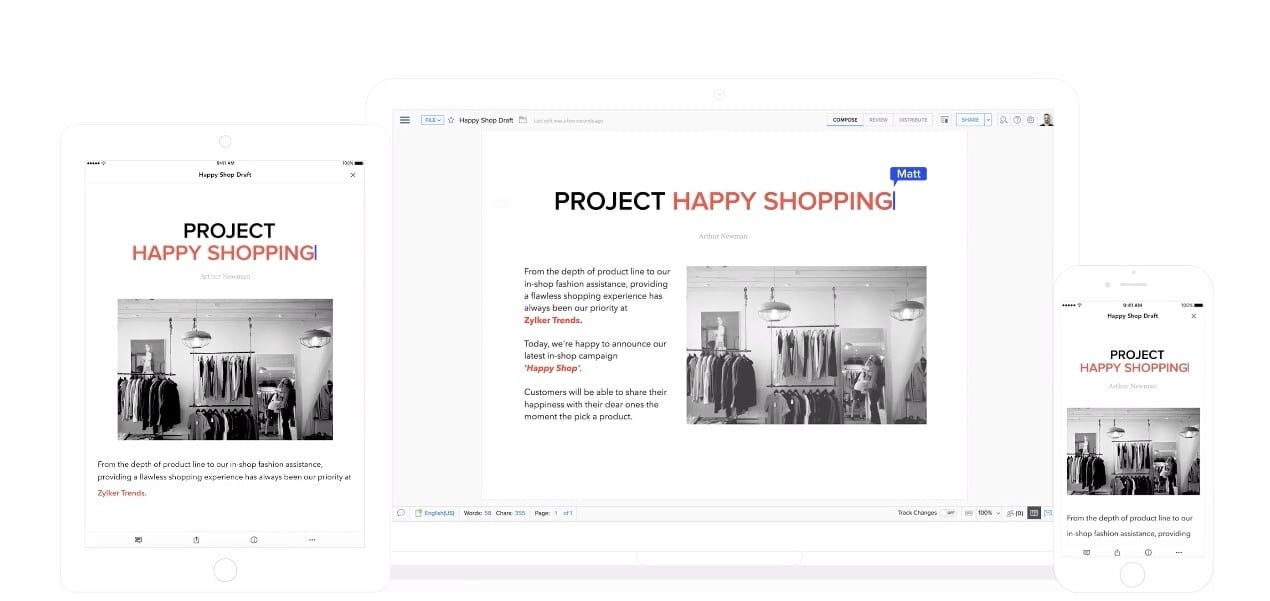
    Zoho Writer

    In this tool, Zia can detect context-based grammar mistakes, rate the document readability, and even suggest style corrections. Zoho Writer also features a new automation hub with document merging, one-click signature, and the creation of documents that can be filled. This tool can also work offline, and it includes distraction-free and focus modes. The cherry on top is that Zoho Writer has an option to enable typewriter sounds, in case you might want to feel like you’re in an episode of Mad Men (hopefully without the gender inequality).

    Zoho Sheet
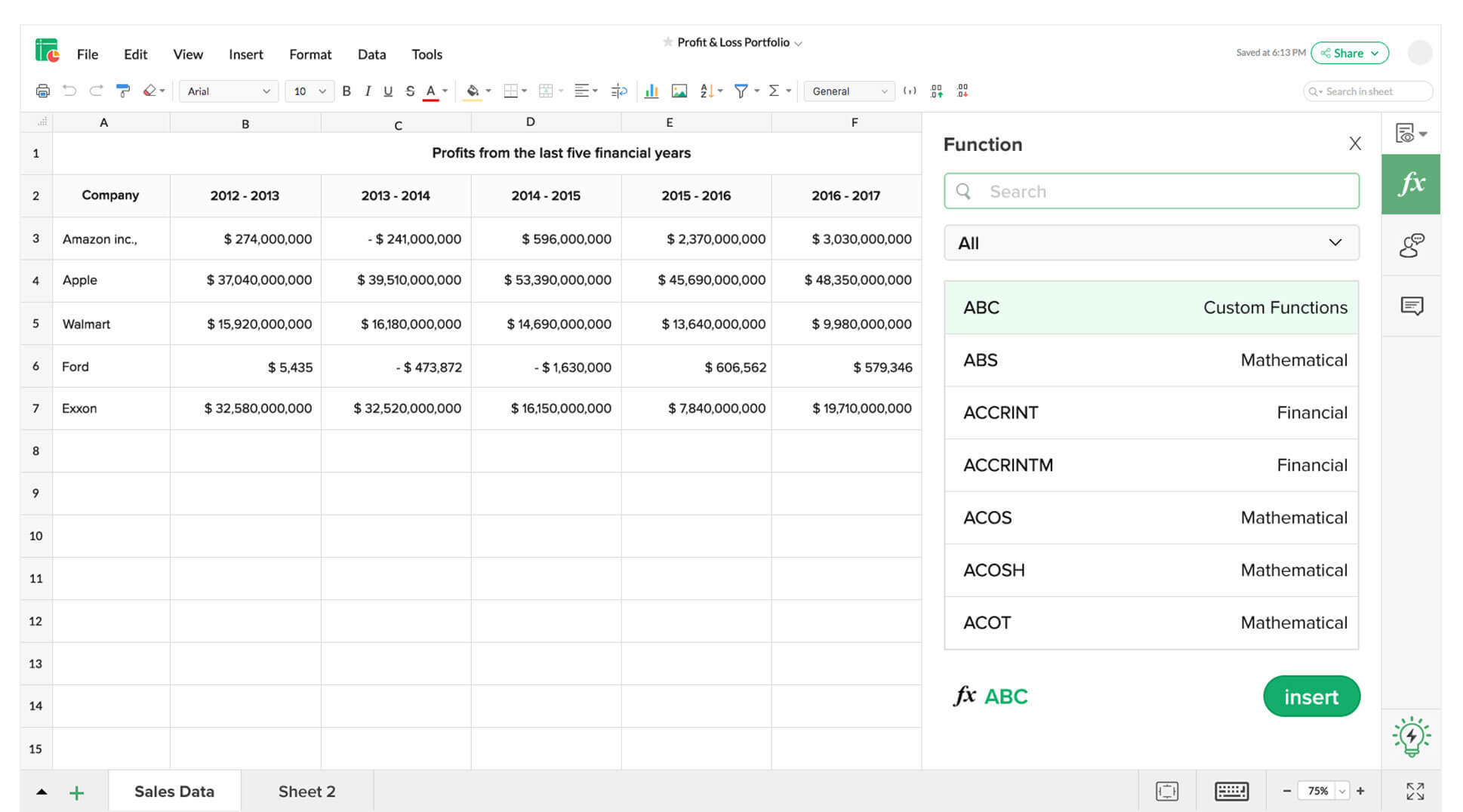
    Here, Zia gives a deep insight of users’ data sets by showing relevant charts and pivot tables. Because Zoho Sheet has Natural Language Querying, users can ask Zia about their data and get from her the chart, function, or pivot table that is suitable. Zoho Sheet is also the first spreadsheet software to offer data-cleaning capabilities, which deletes duplicates and tackles inconsistencies.

    Zoho Show

    If you need to run presentations on Apple TV and Android-enabled devices, then this is your tool! Zoho Show allows this by turning the user’s mobile phone into a controller to beam and control slides on multiple TVs at the same time. This is pretty awesome, but let’s hope in the future Zoho will let us control our laundry with it as well!

    Zoho Notebook
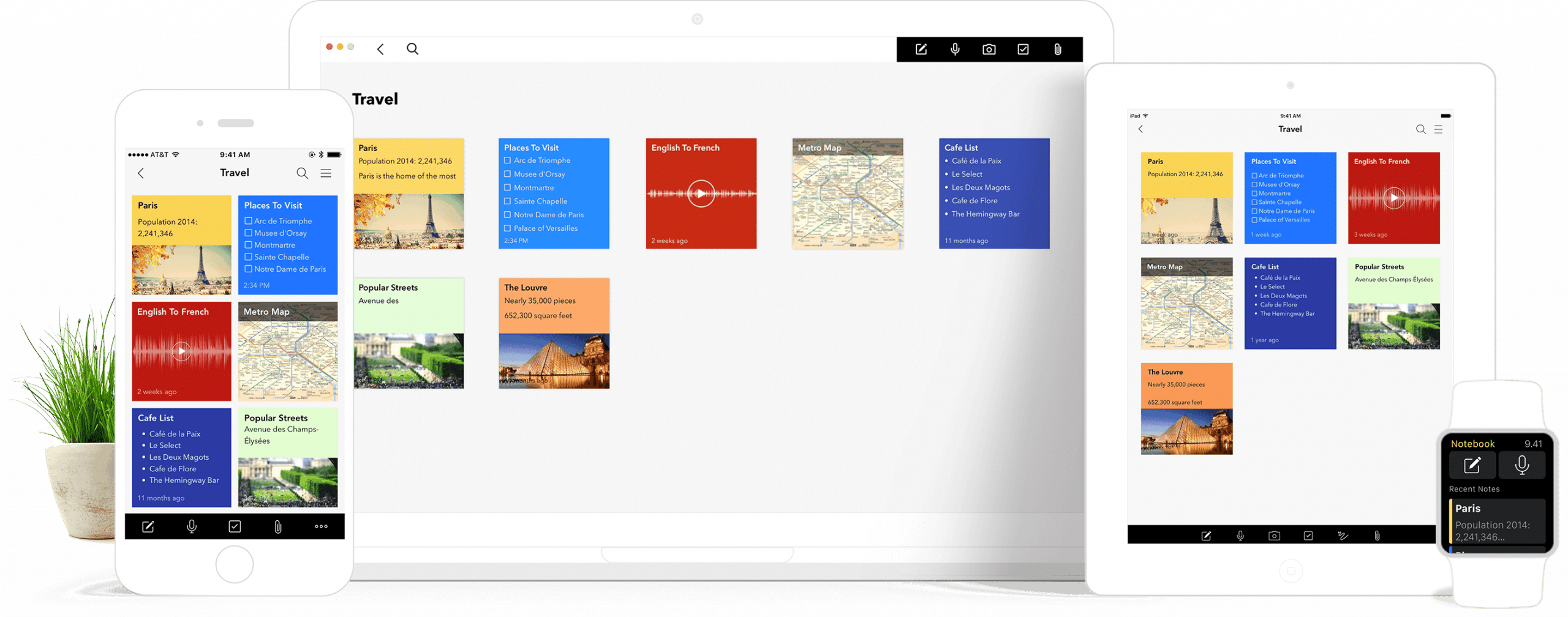
    This one is the newest additions to the Zoho Office Suite family. It has been described by Zoho as “one of the most advanced note-taking applications on the market.” With Zia Voice’s help, users can create a customized recipe “smart card” by taking relevant shopping lists, instructions, and visuals from their favorite website. All these actions are initiated by voice command. Cool, right?

    Regarding the innovations made in Zoho Office Suite, Raju Vegesna, Zoho’s Chief Evangelist, said:

    “We built Zoho Office Suite to be the most integrated suite of productivity tools of its kind. […] We’ve added features and tools that can’t be found anywhere else, such as Notebook’s smart cards, Sheet’s data-cleansing tool, and Show’s integration with Apple TV. It is the combination of these apps, contextually integrated, that makes the modern worker exponentially more productive!”

    With all we’ve read about Zoho Office Suite’s new version, we definitely feel excited!

    To read more about Zoho Office Suite’s new features, click here.

  • Experts’ Predictions for CRM in 2019

    Feb. 18, 2019 — Predictions… Who doesn’t love them? Recently, a group of CRM experts took a look into the CRM crystal ball (which we do hope exists) and made their predictions of what we can expect from CRM this year. Feeling curious? Then keep reading and take a glance at the future. You might be surprised!

    Image by Oleg Magni via Pexels

    AI and Automation

    According to Guy Yalif, CEO of Intellimize, more marketers will use artificial intelligence-based tools in order “to optimize conversion rates to yield better results than the current winner-take-all approaches that treat all prospects the same.” Yalif also mentioned that this year marketing leaders who don’t have much time on their hands will “use machine learning” for the automation of repetitive work that their teams do. Now that’s some help everyone could use!

    Customer Service

    Abinash Tripathy, founder and chief strategy officer at Helpshift, made a statement that, even at this time, seems somewhat bold:

    “2019 will be the death of the phone as a primary customer service channel, as digital customer service gains ground.”

    What’s the reason for this, you may ask? According to Tripathy, the transition from voice-based customer service to digital is moving faster, which will cause messaging-based services like AI and bot-based automation to flourish.

    Another prediction is the reorientation of customer service from reactive to proactive. “In 2019, we’ll see more companies resolving problems almost at the point of origin, often doing so without the customer even having to report it, which will lead to more uptime and, most important, happy customers”, said Bill Patterson, executive vice president and general manager of Salesforce Service Cloud. This sounds great, since we love happiness!

    Meanwhile, Devang Sachdev, director of product marketing at Twilio Flex, stated that customer service agents “will be able to focus on having more intelligent, authentic conversations with customers” instead of performing repetitive actions. According to Sachdev, businesses will use messaging apps like WhatsApp, Facebook Messenger, and Apple iMessage as “new channels” to immerse customers into “conversations with richer experiences.”

    Data Entry

    Maximization of time spent in selling will be happening in 2019 thanks to automated data capture, according to Robin Grochol, vice president of product management at Salesforce Sales Cloud. This definitely sounds like a great opportunity, since sales reps spend an average of “64 percent of their time on non-selling tasks, like data entry.”

    Another CRM forecast for data is regarding Europe’s General Data Protection Regulation (GDPR). Patrick Stokes, senior vice president of product management at Salesforce Customer 360, mentions that thanks to GDPR and the “very real possibility” of regulations like those in the United States and other countries, companies will “have to finally take control of their customer data” to ensure that it will be surfaced across teams in an appropriate way.

    Customer Experience and Brand Personalization

    These two topics have been around for a while now. From case studies to real-time social media interactions, brands have become more humanized, and predictions seem to support that trend.

    “Companies that prioritize experiences, both offline and online, will continue to differentiate through exceptional CX [customer experience]”, said Janelle Estes, chief insights officer at UserTesting.

    Estes affirmed that companies will invest in people, technologies, and processes to deliver “hyper-personalized experiences” in order to meet the constantly evolving expectations from customers, which are associated with the feeling of being known by a brand.

    As you can see, the future is promising for CRM, and we’re very jolly about that!

    Want to read more predictions? Read the full article here.

  • Salesforce Commerce Cloud’s New Tools Embed, Personalize, and Connect Shopping Experiences

    Feb. 4, 2019 — Salesforce has recently announced that it will enable companies throughout its Commerce Cloud platform with tools to bring artificial intelligence, inventory availability services, visual search, and more to a new generation of commerce experiences. These latest developments will empower companies to include innovative commerce experience through voice, phone or social apps, stores, marketplaces, and connected products.

    Image by bruce mars via Pexels

    How These Tools Work?

    These new Salesforce Commerce Cloud features allow companies’ customers to personalize their shopping experience in many ways. For instance, in the “Ask Perry Ellis” Skill for the Perry Ellis brand, a voice-activated personal stylist gives fashion assistance to the shopper to pick up the right outfit.

    According to Vincent Panzanella, the Vice President of Marketing & Communications for Perry Ellis, those innovations have been possible “with Salesforce Commerce Cloud platform APIs and developer tools that we’ve been able to use to reach consumers and offer tailored style suggestions within their day‑to‑day life.”

    What Made This Possible?

    As we’ve all witnessed, the customer interaction with brands has changed in recent years. Customers now stay connected to brands, while engaging with them on the internet through marketing emails, social media, and other experiences as well. This generates the companies’ need to create easy commerce experiences for all their channels. However, all the roads to making a purchase ultimately bring the shopper back to an ecommerce site. That’s a risk on the brands’ side, since they might lose consumers they engaged on one channel while they’re asked to make their transactions on another one.

    This is where the Salesforce Commerce Cloud comes in: its powerful set of APIs, platform services, and developer tools make possible for companies to embed intelligent commerce experiences into every touchpoint in order to impulse growth.

    To make possible the customer experience magic, Salesforce Commerce Cloud allows companies to extend the Einstein AI-powered commerce and image search by sending recommendations to customers, as well as letting them search by photos or screenshots from their phones in order to find merchandise options. The new tools also activate inventory in real time across channels and speed up commerce experiences. To serve those purposes, the following tools were created: Inventory Availability Service, On-demand Developer Sandboxes, Commerce API Explorer, and Commerce Cloud Developer Trailhead Trail.

    To learn more about each of the innovations to the Salesforce Commerce Cloud, click here.

  • Retrospective: What Zoho CRM Brought in 2018

    Jan. 22, 2019 – 2019 is here! Although we’re already moving along with what the new year brings, it’s always good to look back at the accomplishments from yesteryear to keep getting better. That’s what our good friends at Zoho CRM did by sharing their rewind of 2018 which, without a doubt, was an innovative and excellent year! Here’s why:

    The Introduction of Zia

    Zoho CRM introduced us to Zia, an artificial intelligence feature that can receive lead and deal predictions, analyze email sentiment analysis, and send alerts with the best time to contact sales prospects. But that’s not all! Zia Voice lets users have a talk with Zia through voice or chat messages about their CRM data. With all these extraordinary and very helpful features, we can only hope that this year Zia will be able to do our grocery shopping for us! Zia’s acceptance was such a hit that, according to Zoho, it was used by one third of their customers in 2018.

    Blueprint’s Update

    Last year was also great for Blueprint thanks to its new and improved version. Blueprint’s latest update lets the user build and automate sales processes that have a complex nature. It also makes sure that records don’t spend lots of time on a single stage. And how did it turn out, you may ask? 5 times as many Blueprints were triggered in 2018 than the previous year. Not bad, eh?

    New Customization Tools

    Canvas, Portals, and Catalyst joined the Zoho CRM family with fantastic customization options for users. Canvas allows users to customize their CRM by adding items like images, a variety of font sizes, text colors, and custom buttons. More than 50,000 new Canvas creations were made, which means that Zoho CRM users got creative!

    Meanwhile, Portals was made to help involve users’ customers, partners, and vendors with the sales process. This is done by granting them access to key parts of the users’ CRM. In just 10 months, more than 5000 customized Portals were created.

    In the applications field, Catalyst was introduced to build custom applications with web and mobile SDKs. This is possible without having to manage high-priced infrastructure. Over 35% of Zoho CRM’s customers used Catalyst last year.

    Analytics 4.0

    More than 100,000 new dashboard components were added to Analytics. Its latest version lets users to do things like track critical sales metrics, comparing peer-to-peer performances, among others.

    But Wait, There’s More!

    The folks at Zoho CRM know that we love them, which is why they included even more wonderful stuff to build a unique and useful CRM experience to their users. They added Translations, which lets the user translate custom data into their CRM; over 450 extensions like Google Drive and Exchange were added to the Zoho Marketplace; and they made an expansion of their telephony partnerships with over 50 global providers.

    Also, for a more personal Zoho CRM experience, 2018 saw the 7th annual edition of the Zoholics User Conference and the addition of the Zoho CRM Training Program. The latter provides users’ teams the opportunity to learn and become Zoho CRM experts. Either on-site, online, or in workshops all over the world, Zoho makes it possible for everyone. How cool is that?

    Here at InterConnecta we’re very happy and excited for everything that Zoho CRM achieved during the last year. We’re looking forward to what they’ll bring to the table in 2019, and we’ll definitely inform you about it!

    Cheers to our friends at Zoho CRM! To learn more about their 2018 rewind, click here.

  • Zoho Desk Adds Artificial Intelligence After Experiencing New Business Growth

    Zoho Desk, a Zoho customer service help desk application, recently announced the addition of features that are enterprise-focused and a new developer platform, all of this while gaining a 150% growth in new business.

    These new features are industry-first capabilities that allow businesses to improve agent productivity, manage cross-functional service processes, and integrate customer service in context with other business functions like artificial intelligence, service process automation, and mobile applications for supervisors and managers.

    So what does each business function offers? The Zoho Desk artificial intelligence goes by the name of Zia, which gives voice and chat assistance, anomaly reporting, sentiment analysis and triaging, context tagging, contextual availability, and skill building.

    Meanwhile, the service process automation is called Blueprint, which helps managers to create service processes that their teams can follow. It creates efficiency by making and deploying Blueprints in minutes. Because agents only see the actions applicable to them, they are able to respond quickly. Blueprint also enables proactiveness by allowing service managers to see the performance of their processes and which stages go through holdups, so they can deal with them in a proactive manner.

    Lastly, mobile applications for supervisors and managers are under the name of Radar. Made for iOS and Android, Radar helps decision-makers like supervisors and managers to look at their customer support operation from a performance perspective.

    Read the full article in Zoho.

  • Tim Cook Calls for GDPR Style Privacy Laws in the U.S.

    Engadget reports: Apple CEO and long-time data privacy advocate Tim Cook has made an impassioned speech calling for new digital privacy laws in the US. At a privacy conference in Brussels, Cook said that modern technology has resulted in a “data-industrial complex” where personal information is “weaponized against us with military efficiency,” and in a way that doesn’t just affect individuals but whole sections of society.

    “We are optimistic about technology’s awesome potential for good. But we know that it won’t happen on its own. Every day, we work to infuse the devices we make with the humanity that makes us.”

    Follow EU’s Lead

    Cook praised Europe’s “successful implementation” of privacy law GDPR, and said that “It is time for the rest of the world… to follow your lead. We at Apple are in full support of a comprehensive federal privacy law in the United States.” He outlined four key areas that he believes should be turned into legislation: the right to have personal data minimized; the right for users to know what data is collected on them; the right to access that data; and the right for that data to be kept securely.

    Cook has been outspoken about privacy rights before, and has repeatedly called for tougher regulations in the past — something which has jarred with critics claiming such regulations would be an obstacle for innovation. However, he pre-empted this take during his Brussels speech. “This notion isn’t just wrong, it’s destructive,” he said. “Technology’s potential is and always must be rooted in the faith people have in it.” He then followed up his speech with a tweet that asked:

    “It all boils down to a fundamental question: What kind of world do we want to live in?”

    Changes are already in the making in the U.S. Earlier this year, California passed a sweeping privacy law that “gives consumers the right to demand that their data be deleted and to bar companies from selling their data without them losing access to services or being charged a higher price.” The question is what will these laws look in other states and countries, and what will they mean to us all, people and businesses alike.

    Read the full article in Engadget.

  • IBM is acquiring Red Hat for $34 Billion

    IBM has struck a deal to acquire the cloud software company Red Hat for $34 billion.

    Here are the key points from the deal announcement:

    • IBM will acquire all of the issued and outstanding common shares of Red Hat for $190.00 per share in cash, representing a total enterprise value of approximately $34 billion.
    • JPMorgan advised IBM on the deal and provided most of the financing. Lazard also advised IBM. Guggenheim Partners represented Red Hat on the deal.
    • IBM will remain committed to Red Hat’s open governance, open source contributions, participation in the open source community and development model, and fostering its widespread developer ecosystem.
    • IBM and Red Hat also will continue to build and enhance Red Hat partnerships, including those with major cloud providers, such as Amazon Web Services, Microsoft Azure, Google Cloud, Alibaba and more, in addition to the IBM Cloud.
    • Red Hat will join IBM’s Hybrid Cloud team as a distinct unit, preserving the independence and neutrality of Red Hat’s open source development heritage and commitment, current product portfolio and go-to-market strategy, and unique development culture.
    • Red Hat will continue to be led by Jim Whitehurst and Red Hat’s current management team. Jim Whitehurst also will join IBM’s senior management team and report to Ginni Rometty. IBM intends to maintain Red Hat’s headquarters, facilities, brands and practices.
    • “IBM will become the world’s #1 hybrid cloud provider, offering companies the only open cloud solution that will unlock the full value of the cloud for their businesses,” Ginni Rometty, IBM chairman and CEO, said.
    • “Joining forces with IBM will provide us with a greater level of scale, resources and capabilities to accelerate the impact of open source as the basis for digital transformation and bring Red Hat to an even wider audience – all while preserving our unique culture and unwavering commitment to open source innovation,” Jim Whitehurst, president and CEO of Red Hat, said.

    Source: Business Insider (View full article)

  • Announcing Zoho CRM 2018: Get Ready To Sell Smarter, Better, Faster.

    Introducing Zia Voice
    The first conversational AI for sales teams
    An interactive CRM is all you need to make your business smarter. The first conversational AI for sales teams, Zia Voice lets you talk to your CRM through voice or chat. Get access to CRM information that’s timely, contextual, and available, right when you need it.

    The Even Smarter Zia

    An assistant you can always count on
    An assistant is someone you can always count on. Your CRM assistant should be no different. Zia can now predict your lead or deal closures, read email sentiments, and alert you to use the best time to contact a prospect, which she has suggested. What’s smarter? She also intelligently analyzes the performance of your workflow automation, provides a dashboard that has intelligent components, helps you map your current trends as compared to expected results, along with auto-populating lead information in your CRM, so you spend less time on data entry.

    Blueprint: Sell On Time. Every Time
    With SLA and Checklist enhancements
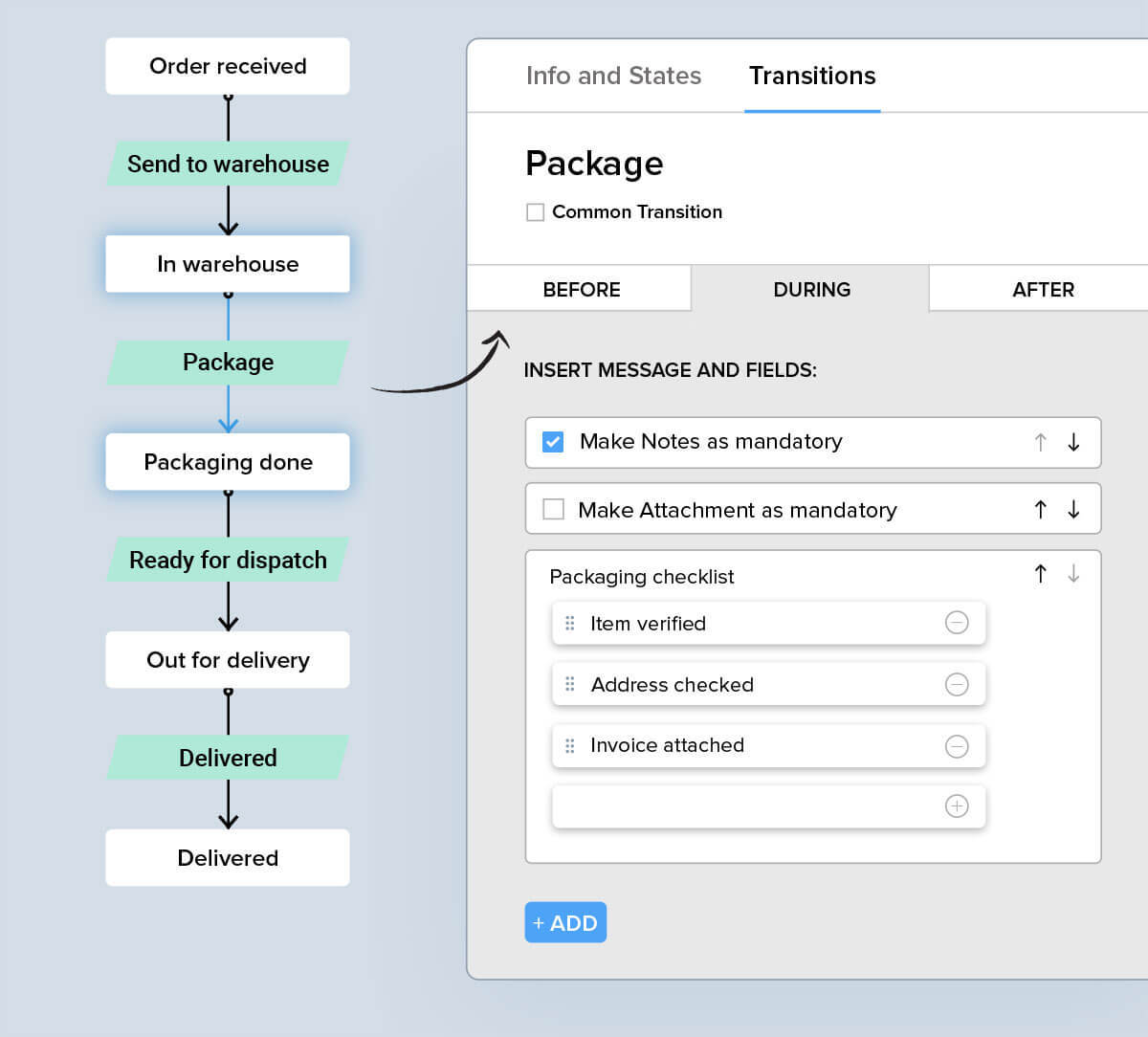
    Time is money, especially when you’re making a sale. Blueprint in Zoho CRM helps you build and automate your sales process just like you designed it. Blueprint’s newest functionality? The ability to mark all tasks complete before salespeople move to the next stage along with specifying the time a record should be in a particular state for.

    Analytics
    A smarter dashboard for your business
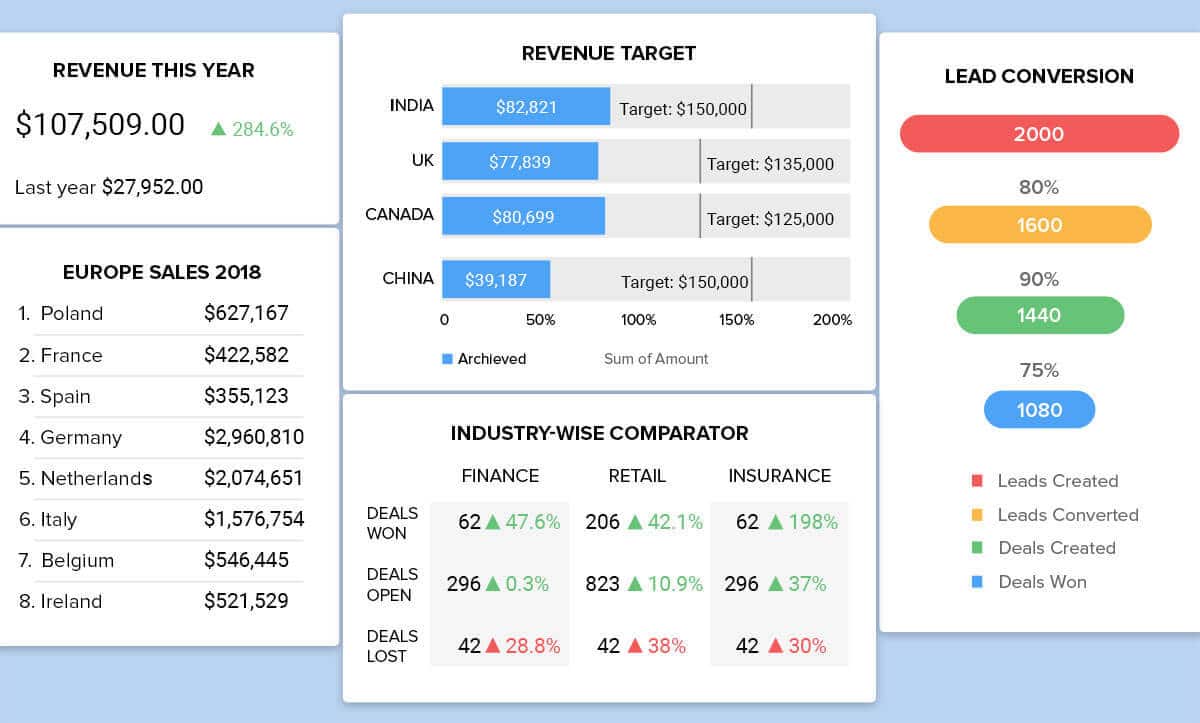
    Zoho CRM’s user dashboard gets a brand new interface, with the addition of 5 new analytical widgets that will redefine how sales teams draw business insights. Get your own customizable dashboard that will help you track sales metrics and visualize key performance indicators. Stay on top of sales trends by detecting anomalies in your sales cycle, or compare peer-to-peer performance or deal closure cycles with the help of the Spot Comparator.

    Portals
    A true self-service platform for CRM
    Keep your sales team close, and your customers closer. With access to all past purchases, cases, and invoices, Portals allows your customers, vendors, and partners to make more informed buying decisions.

    Catalyst
    A hyper-customization platform for businesses of all types
    One of our biggest releases this year for Developers, CRM administrators, and IT implementors. Catalyst, a hyper-customization platform, allows you to build custom applications on your CRM platform and replicate your unique business needs and processes.

    Canvas
    Paint your own CRM view
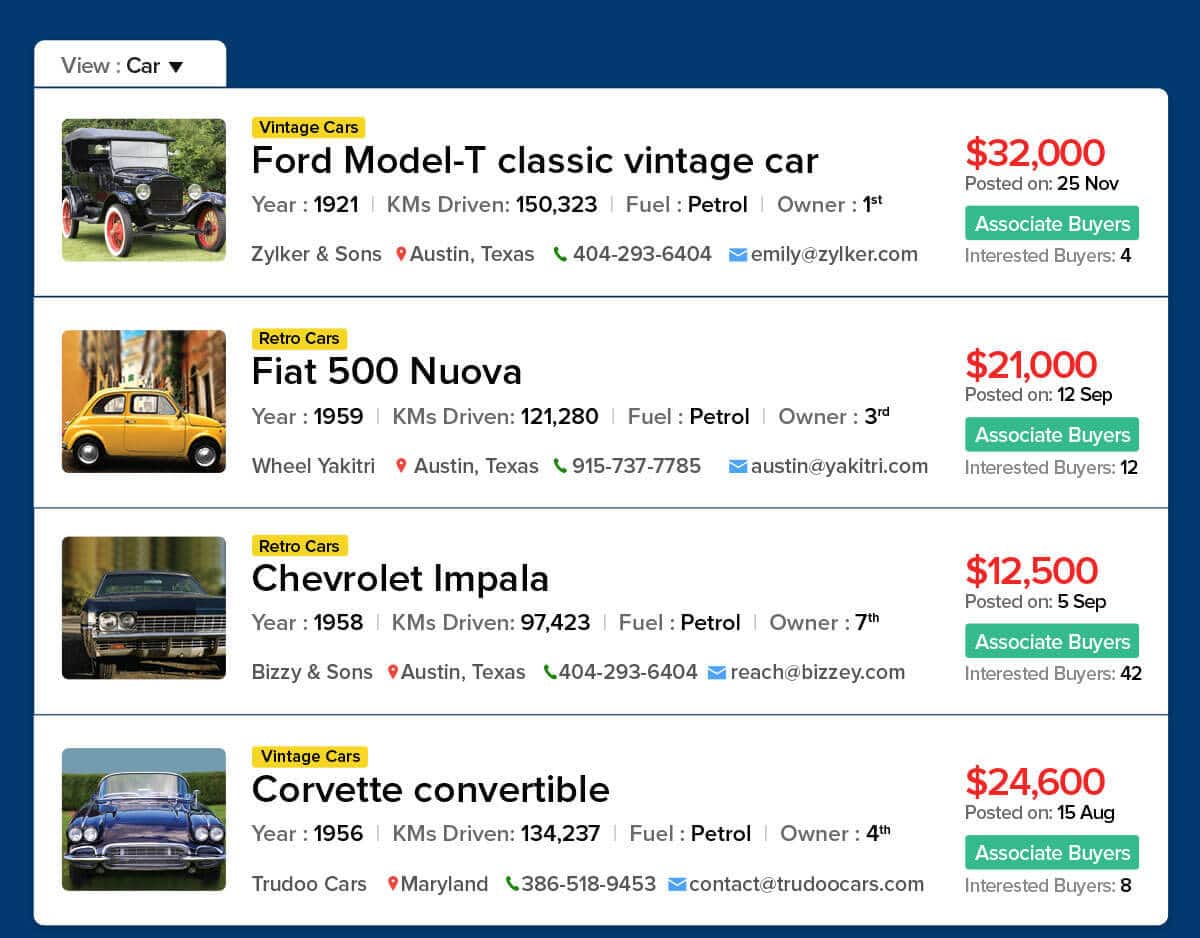
    Your traditional data arrangement with CRM gets a twist. Customize the List View of your Zoho CRM account with the industry’s first-of-its-kind view. Add images for easy identification, use custom buttons to create fields of your choice, and get your view completely customized based on your business needs.

    Subforms
    View related CRM data from a single place
    Simplify the way you view CRM information with Subforms in Zoho CRM. View the entire order history of a single customer, in one single place.

    Translations
    Make CRM speak the language you do
    With Translations, your CRM information is available to your team in the language they’re most comfortable with, keeping that local flavor of every business intact.

    Validation Rules
    Ensure the right data flows into your CRM
    Frame different rules for different modules and fields, along with error messages that should show up when invalid data tries to enter your CRM.

    Data Encryption
    Your data is safe with us
    Zoho CRM uses one of the strongest encryption standards, AES-256, to encrypt your data. This means your data is protected from outside access, and can be read only if decrypted. By encrypting your data that’s stored in Zoho CRM, we prevent any possible security leaks or breaches to your data.

    Zoho Meeting And GoToMeeting
    For effective virtual meetings
    Set up web conferences to follow up with clients inside CRM. Every new event, or meeting, contains a details page in Zoho CRM, where your team can access the audio-video recording of the conference and relevant documents shared during the meeting.

    Note: These features will be rolled out in a phased manner.
    Via Zoho CRM.

  • What’s in your Sales Stack?

    SMB teams are finally able to leverage the same level of technology as large enterprise sized company’s. Amazing Software-as-a-Service (SaaS) sales apps are coming to market at a rapid pace and they’re affordable. These focused apps are leveling the playing field between the enterprise sales engines and the little startup, and unlike your traditional sales tools, these light-weight sales apps possess enough features to get the job done without becoming bloated and hard to use.

    The problem arises when you try to use a number of these focused sales apps together to create an integrated sales workflow — a.k.a. your sales stack.

    The problem with the disconnected sales stack

    Unlike the software large corporations use, each piece of your startup’s sales stack is usually made by a different company, does a very specific job, and doesn’t necessarily play well (synch) with the rest of your sales stack. This makes for an unstable sales stack that is just waiting to break / disconnect.

    Worse, when your sales tools don’t play nice together, manual data entry is required to keep your entire sales stack in sync.

    If your sales team is wasting time with manual data entry – they aren’t spending time closing their sales activity and revenue quotas.

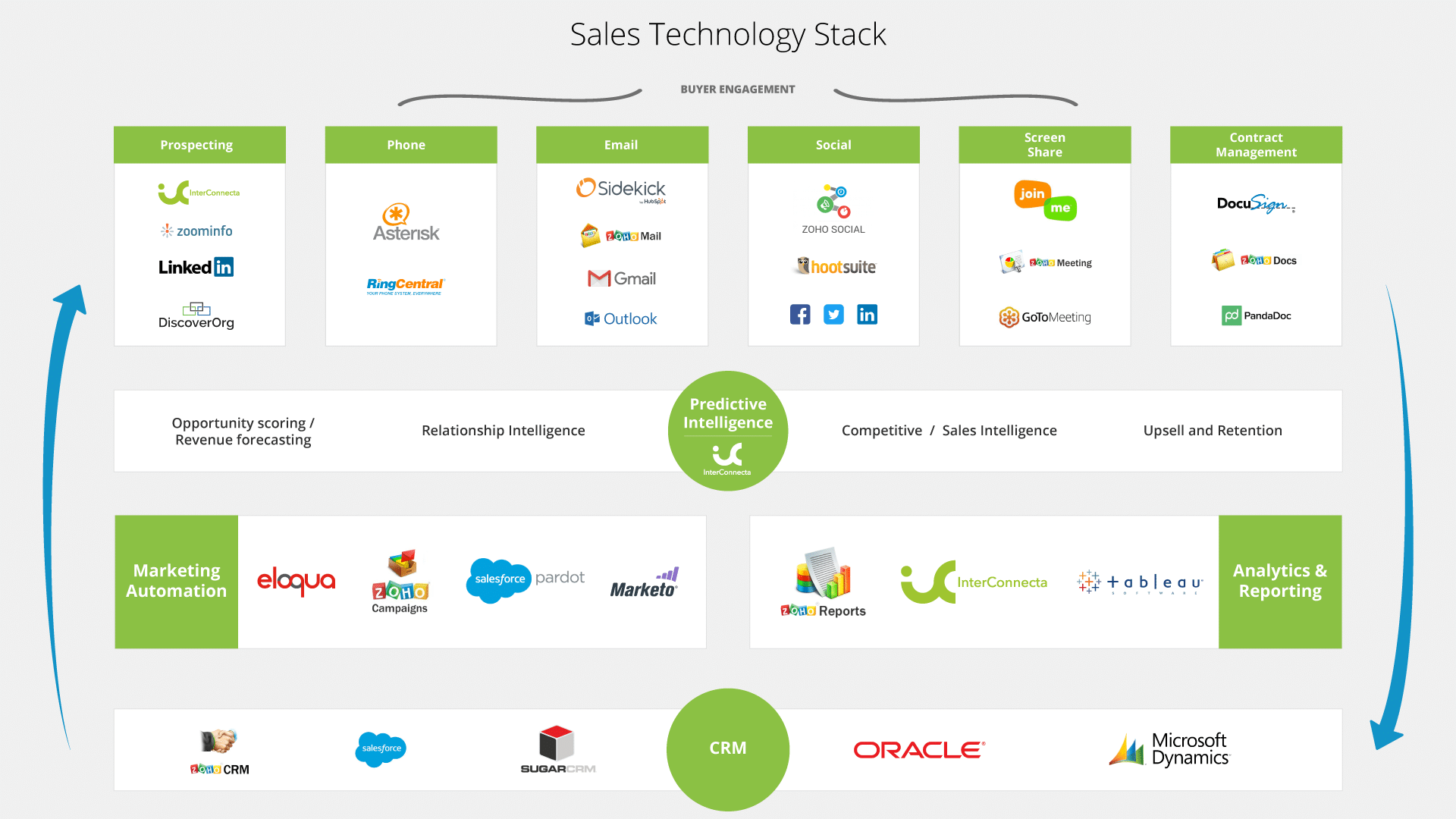
    Below is an example of an SMB sales stack, that covers most sales activities across all levels of the sales funnel.

    Contacts

    • List Building – data.com / discovery.org /
    • Contact Info – SalesLoft / LinkedIn/ google
    • Lead Research – InsideView/GageIn/LinkedIn
    • Segmenting – Zoho CRM
    • Email Tracking – Zoho Campaigns / Pardot / Vertical Response

    Qualified

    • Pre-call Research – InterConnecta / Linked-in /
    • CRM – Salesforce/Zoho CRM/SugarCRM
    • Note Taking – Evernote
    • Dialer – InsideSales

    Demo

    • Demo Software – Join.me
    • CRM updating – Cirrus Insights / InterConnecta
    • Content management – Zoho Documents / Dropbox/Box

    Proposal

    • Proposal creation – Zoho Invoice / CRM
    • E-signature – Echosign/PandaDoc

    Closed

    • Contract management – Zoho CRM / Zoho Invoice
    • Referral – Influitive

    Each of these tools does their small piece of the sales process extremely well, but creating a complete sales workflow by getting them to work with each other, to send data between each other automatically, and to stay in sync without manual data entry is important. It requires leveraging API’s (application program interface) to build data “pipelines” between each app. If this sounds highly technical, that’s because it is. This is work for software engineers.

    Like many of you, we are a startup ourselves. So, I know that your engineering talent is already giving 110% just trying to develop your own product and address your own bugs. They don’t have time to fumble API’s.
    That’s where InterConnecta attacks.

    InterConnecta’s mission is to integrate your sales stack and fill the holes in your process either with people or technology.

    At InterConnecta, we want to empower startups and SMB sales team by helping them identify and integrate their own sales stack made up of the best SaaS tools.Just simple point ‘n’ clicks and drag ‘n’ drops to get the job done.
    We code and develop all of those API’s for you so that the complicated stuff hums along in the background without you having to worry about it. Just tell InterConnecta where you want your data to go and when, and then watch it go there automatically, without having to scratch your head. We add our own telephone based sales reps and launch multi-channel marketing campaigns on your sales stack so that we experience real life sales development scenarios “with you” during the setup of your sales stack; giving us real time insights into your operational sales flow and help adjust the automation on your sales stack accordingly. Just consider us your sales “pit crew” right out there on the track with you.

    And here’s why you should care:

    • Real live veteran sales representatives working hand in hand with your sales teams to help architect the most useful and adoptable sales stack configuration.
    • Real time analysis on your messaging and how its being receivedReal time analysis of the Lists you are using and if the contacts are any good or outdated.
    • More automation / Less copy/paste to keep your sales stack in sync means more time for sales activities like generating leads, calling leads, doing demos, and closing deals.
    • You reduce the human error that occurs when you get your talented team to do mundane manual data entry instead of what they were hired to do.
    • Leaving your team to build and maintain product means bringing better products to market faster.

    Results?

    • CRM is always up to date with detailed sales lead information.
    • Real time insight into your “pitch” and the lists your working on.
    • New signups are added to you Email subscriber and CRM lists automatically.
    • Lead scoring helps determine the level of sales follow-up requiredSales activites are auto-created and assigned to proper sales rep for follow up based on territory or special rules.
    • All of this happened the moment a prospect hit the “Submit ” button on our InterConnecta forms and surveys, all branded with your company logo and theme; and it all happens without you needing to learn code or hassle your team.

    And this is just the very beginning…

    We have some exciting things on the horizon, such as:

    • Automated Analytics – for that mobile executive who needs data at a glance.
    • Real time auto campaign suggestions / based on historical marketing results.

    We truly believe it’s possible to have the same power an enterprise sales team possesses by modifying light-weight open source sales apps combined with the integration and automation your current proven sales process requires.

  • 3 CRM Features Ignored by Small Businesses

    Having a CRM means a lot more than just signing up for a free account and dumping your data on the cloud. There are ways to make the best of your new system and Brent Leary, cofounder of CRM Essentials, knows this well. In this guest post for Destination CRM, Brent discusses the most important CRM features that small businesses don’t take advantage of. Here we’ve highlighted our top 3.

    Automating Important Processes

    Look for options that enable users to be more effective at engaging customers and prospects by unifying contacts into a single system of record; enriching those records with company and business insights; and empowering them to engage everywhere they work.

    At InterConnecta we are thrilled every time we’re able to find ways to save our users some time in their daily workflow because we know this can add up to hours saved of time and a much smoother user experience. From automating incoming leads while preventing duplicates to keeping users on top of their game with notifications; if you’ve been running a CRM without automations, you’ve been doing it wrong.

    Managing Relationships. Not Data

    Insightly chief marketing officer Tony Kavanaugh notes that SMBs need to focus more on the “R” part of CRM. “CRM deployments should treat sales force automation as table stakes and focus on what it takes to make the buyer journey as frictionless and as fruitful as possible. Relationship scoring and intelligence, sentiment and signal analytics, next-best-action recommendations, project delivery, and AI-based advice at every step of the buying journey are all key to this new imperative.”

    One key feature of CRMs is the ability to shape your data by creating relationships across modules. This may be a difficult concept to grasp at first but it is very important if you want to ensure that your database can grow. Companies nowadays not only manage customers but a broad range of relationships from the Account they belong to, Deals closed, Emails sent, and even custom data that are specific to the company’s workflow. Every item needs to be captured and accessible. Maintaining these relationships and understanding how they add value to your sales process will help you make strategic decisions.

    Connect All your Systems

    SugarCRM CEO Larry Augustin also thinks integrated data can help more SMBs succeed. “We find it surprising that a lot of CRM users are not yet leveraging third-party data sources and services to augment the data in their systems. CRM has seen some adoption issues, specifically because users don’t want to put data into the system. And using data services does the heavily lifting for users, driving adoption in addition to enhanced productivity.”

    Taking things one step further, you can connect not only the data inside your CRM but to the data in other systems. Whether it is your marketing hub, books, ads, or business intelligence system; integrating other systems with your CRM will give you greater insight into the performance of your business while making your users more efficient.

    Brent Leary is cofounder of CRM Essentials, an Atlanta-based advisory firm focused on small and midsize businesses. He is also the author of Barack 2.0: Social Media Lessons for Small Businesses.

This site is registered on wpml.org as a development site. Switch to a production site key to remove this banner.