Author: user

  • Zoho is Named a Leader in Nucleus Research CRM Technology Value Matrix 2021

    Just a few months after being named in all four Gartner Magic Quadrants, Zoho achieves another prestigious recognition by being named a Leader in the Nucleus Research CRM Technology Value Matrix 2021.
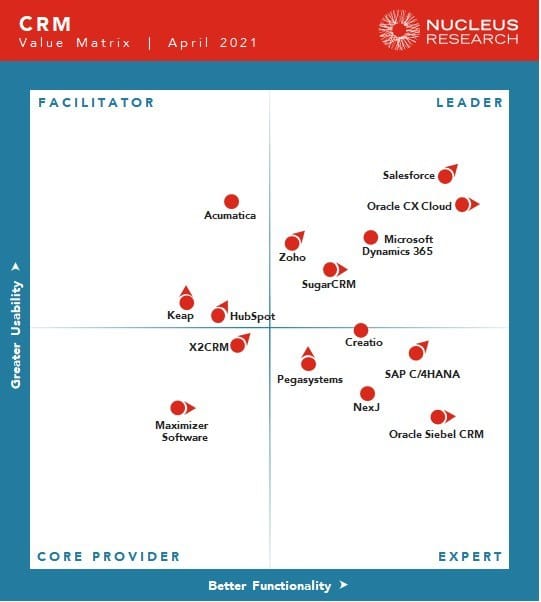
    Image via Nucleus Research

    Nucleus Research, a global provider of ROI-focused technology research and advisory services, generates their Value Matrix based on in-depth interviews with end users and customers, vendor participation, and extensive ROI assessments of technology deployments. The vendors’ assessment is based on usability and functionality, two of the key factors that give impulse to long-term value.

    In their Value Matrix report, Nucleus Research stated the following:

    “With the breadth and customizability of the Zoho platform, customers can truly run their entire businesses with Zoho. This puts Zoho into a league of behemoth technology vendors like Microsoft, Salesforce, and Oracle. We have consistently seen Zoho move upmarket as the platform has increased in breadth and capability, to where now it is a viable platform for enterprise-size organizations around the world.”

    The Miami-based technology research company also mentioned that “two increasingly compelling reasons” to partner with Zoho are its unified data model and private cloud approach, both of which separate Zoho from its competitors. Nucleus Research explains that the unified data model enables cross-departmental visibility and process integration, something that has become crucial during pandemic times as more work is done from distributed settings. “The ability to integrate data and unify business areas on a single platform will come increasingly into demand”, reveals the report.

    Nucleus Research also praises Zoho’s quick innovation pace and product development, which results in being well positioned to gain market share from customers who seek a lower-risk approach to heighten CRM sophistication, as well as the modernization of legacy deployments. All these elements plus a functionality that’s complete and competitive, fast deployment times, and endless customization and process digitization potential, are the qualifications that make Zoho a Leader in 2021’s Value Matrix.

    To read the full article, click here.

    Are you interested in learning more about Zoho’s applications or implementing them in your business? Then reach out to us by clicking here. We’ll be happy to help!

  • Zoho Releases Qntrl for Low Code Workflow Automation

    2021 has been a great year for workflow automation, which has been strongly trending since last year. Now, Zoho Corporation has launched a new low code workflow product called Qntrl (pronounced control) to supply the demand in this area.

    Image via Qntrl

    According to Rodrigo Vaca, Qntrl’s Chief Marketing Orchestrator, most of the workflow automation solutions out there have been built for larger enterprise customers. With Qntrl, Zoho targets the mid-market with a product that demands less technical expertise than conventional business process management tools.

    “We enable customers to design their workflows visually without the need for any particular kind of prior knowledge of business process management notation or any kind of that esoteric modeling or discipline,” stated Vaca.

    Though Qntrl, according to Vaca, might require some technical help to connect to a workflow to more complex backend systems like CRM or ERP, it gives a less technical end user the option to drag and drop components and get help later to complete the rest. Vaca also mentioned that Qntrl puts this type of tool in reach of companies that may have been left out of the workflow automation, or have been using spreadsheets or other tools for crude workflow creation. Qntrl allows to drag and drop components, and then choose each one and configure what happens before, during, and after each step.

    Also, Qntrl offers a central place to process and comprehend what happens within each workflow at any moment and the person responsible of its completion.

    Over the last year, low code workflow automation has acquired a bigger role in businesses. Large companies like Microsoft, ServiceNow, SAP, and others have been providing this functionality in 2020. This necessity has grown during the pandemic when many workers couldn’t be in the office, which made more compulsory to shift work in a more automated workflow.

    To read the full article, click here.

    Are you interested in learning more about Zoho’s applications or implementing them in your business? Then reach out to us by clicking here. We’ll be happy to help!

  • The Three C’s of CRM Data Optimization

    Crucial, correct, and consistent: that’s how your CRM data should be.

    Those are “the three C’s” of CRM data optimization. However, not all companies have those characteristics. According to an IBM report, one in three business leaders mistrust their data quality, while companies from the United States lose about $3.1 trillion in annual revenue because of bad data.

    To save your business from falling into a bad data rabbit hole, check out these tips on how to make sure that your data is crucial, correct, and consistent:

    Image by Luke Chesser via Unsplash

    Make it Crucial

    Each and every field must have a reason for existing for data collection. Having too many fields that are not justified can cause to capture more data than needed. In order to identify the actionable data that your business really needs, you must work with your organization’s departments and stakeholders. Once you do that, express your reasoning to all the CRM users so they can understand what data is needed and its importance. A great way of communicating this is adding information bubbles to each field with a short explanation.

    Make it Correct

    Unfortunately, data expires quickly. A report from Dun & Bradstreet from 2018 revealed that every hour 13 companies would change their names, 211 businesses would move, 429 business phone numbers would change or be disconnected, and 284 company CEOs or owners would change.

    Since people won’t tell you to update your data, you must do it and verify it yourself. You can identify records that can’t be contacted and flag open opportunities they’re associated with to understand why an opportunity is open over its close date. By doing this, you’ll be able to locate at-risk opportunities before their close dates arrives to pass without any sale.

    You might also want to consider streamlining your CRM’s user interface if it’s complicated. This will allow you to increase productivity and the chances that your data will be accurate, complete, and entered on time. Also, it helps when CRM users comprehend the consequences of having data that’s inaccurate and incomplete. For example, a missing job title or job level might result in a quality lead getting overlooked or not properly scored.

    Image by Lukas via Pexels

    Make it Consistent

    The Gartner State of Sales Analytics report from December 2020 revealed that only 25% of businesses had a standard and organization-wide definition for sales metrics, which is a core aspect to any businesses. It’s essential to create standardized definitions, as well as making sure that everyone uses them. With that in mind, your data must be stylized in a reportable and functional way. This includes eliminating duplicates (a constant in any CRM) and making sure that your CRM is usable for all stakeholders. Ask yourself: Can executives analyze data easily? Is the sales team able to easily manage its pipeline and generate forecasts? Also, is customer support able to access everything they need to manage cases in an efficient manner? If your answers are no, then you might have to improve your data to be more actionable and accessible.

    Making it Crucial, Correct, and Consistent is an Ongoing Process

    CRM data optimization isn’t a one-time only activity. It is an ongoing and strategic process of maintaining and monitoring your data. To ensure that better-quality data will enter the system, you must educate your CRM users and make easier their data entry process. Once you focus on the three C’s to have the right and consistent data, your CRM users will feel confident when using the correct data and they will be able to do their jobs seamlessly and with positive results.

    To read the full article, click here.

    Do you need help with your Zoho CRM or are you considering implementing it in your business? Then click here and sign up for a trial of Zoho CRM.

  • Zoho’s Finance Trends: Rise in Cloud-Based and AI-Driven Accounting Will Happen

    Prashant Ganti, Head of Product Management Global Tax, Accounting and Payroll Solutions for Zoho Corporation, discussed some predictions for finance trends in 2021. According to Ganti, AI has now a larger role in accounts payable automation and spend management. This can be seen in the extraction of information from receipts and invoices, fraud and duplicates detection, and automatic invoices’ routing to the next stage of processing, which would eliminate manual data entry processes.

    Photo by Karolina Grabowska via Pexels

    Also, Ganti said that AI will have a major part in the reconciliation process. This will result in transferring lots of low-level tasks from the hands of accountants and other financial professionals to a computer. That will leave more free time on their hands to focus more on strategic initiatives.

    Here are other finance trends from Zoho:

    Cloud-Based Accounting Will be Accelerated

    Because of the pandemic, several years of digital transformation have happened in only a few months. Cloud-based accounting solutions have been crucial in the successful transition to remote working. Cloud accounting allows many things, like breaking the communication bottleneck between internal and external entities like accountants, CFOs, and business owners; more productivity because of data entry elimination; and the ability of getting real-time insights from multiple business sources to provide leading indicators of a business’ future performance.

    Uninterrupted Accounting

    Mobile and cloud technologies have allowed computing to be continuous. Current technology can help design financial processes that become a fundamental part of processing activities like financial close and continuous accounting, which brings operational efficiency without having to set aside days dedicated to period-close activities.

    Finance Will be Driven by Customers

    According to Ganti, finance will function beyond its conventional focus areas of costs and compliance to play a strategic role in organizations. Therefore, finance and accounting will have to be more customer-driven. This can be achieved by designing processes to maintain the customer at the center. All finance and back-office systems will have to be integrated with other business systems, while providing relevant information to every user to be able to serve customers better. Finance will also require the implementation metrics that highlight customer growth and experience.

    Analytics Will be Finance-Governed and Self-Service

    Finance-governed analytics that brings together financial, operational, and transactional data in a unified way will emerge. Accountants and finance professionals will be able to run queries on data that covers an entire company thanks to AI tools like CFOs and natural language processing. This will support operational and strategic decision-making.

    The Rise of Full-Stack Finance Professional

    Because no-code and low-code platforms keep evolving, accountants and finance professionals will be able to develop solutions by using deep technology to help their organization. This has made possible the advent of full-stack finance professionals, along with AI, self-service analytics, among other tools.

    The Merge of Banking and Accounting Will Continue

    Banks now offer their services in their mobile apps, while integrated banking technology is developing. This means that the days of accounting and banking as separate units are long gone. Nowadays, many modern accounting solutions offer bank integration, which makes account reconciliation quicker and easier. As more mobile accounting apps continue to connect with mobile banking apps, business owners won’t have to depend on computers.

    To read the full article, click here.

    Are you looking for a cloud accounting solution? Then click here
    to learn about our Zoho Books implementation.

  • Perú Becomes One of the Top Latin American Countries with Largest Growth of Digital Consumption

    Comscore, an American media measurement and analytics company, recently published their report titled “Perspectives on the Latin American Digital Scenario” (Perspectivas del escenario digital latinoamericano), which presents its current status after the pandemic’s impact. Also, it details the Latin Americans’ new digital behaviors, which depends on the country.

    Image by Pixabay via Pexels

    According to Alejandro Fosk, Senior Vice President for Comscore in Latin America, the historic year that we have been living because of COVID-19 has made all things digital a key component in everyone’s lives. Fosk expressed that “capturing the persons’ online behavior implies understanding trends that will probably persist over time.”

    Meanwhile, Gustavo Sambucetti, President of the Argentine Chamber of Electronic Commerce, commented on how users increased their online purchases, while others ventured on it for the first time. “Two out of three users are new. On one side, there were customers who regularly made online purchases and started to buy online in more categories. On the other side, there were first-time customers who had never made online purchases and started doing it because of being forced by the pandemic, the quarantine, and the need of acquiring different kinds of products or services,” said Sambucetti.

    ComScore’s study revealed that, when the restrictions caused by the pandemic began, there was an increase on page views’ numbers, with Argentina, Perú, and Chile as the three Latin American countries that stood out the most. Of these three, Chile had the biggest digital audience growth by 7%, which doubles the increase registered in other Latin American countries. Meanwhile, in Perú there was a 3% increase, going over countries like Colombia, Argentina, and México, which had a 2% increase.

    “The trend is clear: Perú has a larger average growth than other countries because we [Perú] were more left behind,” said Daniel Falcon, CEO of Neo Consulting. Falcón considers that the large growth in Perú —in comparison to other regions— is also happening because of the low consumption levels that digital channels had before the pandemic.

    According to Comscore’s study, the use of desktop prevails in Perú to access the internet or social media. (Image by Ken Tomita via Pexels.)

    Regarding the usage of tech gadgets to use the internet or social media, Comscore discovered that Peruvians do it mostly from desktop computers; while in Brazil, smartphones dominate that area.

    For 2021, because of the pandemic, the expected trend is that digital consumption will continue to rise, and that the importance of social media will be highlighted beyond a communication form between users. Sambucetti said the following about that:

    “There is no longer any business that thinks that e-commerce or digital interactions are something marginal. Social media had an important peak by going from its sole role as a communication tool to take over a transactional role.”

    Another finding from Comscore’s study and that marks a difference in the Peruvian audience from the rest has to do with the social media usage. In Perú, Facebook prevails against the other social media channels with 72%. Instagram follows in a second place with an interactions’ share of 21.5%, which represents a significant distance between both platforms. According to Falcón, “[Facebook] is a channel for mostly adults and older adults, since young people can be found in Tiktok and Instagram”.

    Falcón also mentioned that the differences in terms of digital consumption between Latin American countries are decreasing. In fact, he predicts that from now on this will be the trend, since there isn’t much difference anymore between Perú, Colombia, and Chile by being in more similar levels. Falcón also expressed that even though Argentina and Brazil are way ahead, it’s important to take into consideration that “Perú has been very left behind in digital commerce and online education, yet very advanced in social media usage.”

    Without a doubt, digital consumption is in an all-time high, despite the challenges that these new pandemic times have imposed.

    To read the full article in Spanish, click here.

    Are you looking to take your business to the digital transformation? Click here and learn how we can help you implement digital solutions.

  • Hybrid Work Model: Tips for a Successful Implementation

    Remote work is a still ongoing topic during the still ongoing pandemic. Many discussions have started about it, including the implementation of hybrid work, which gives the option to employees to work both on site and remotely. Recently, Rajendran Dandapani, Director of Engineering from Zoho Corporation, added to the discussion in an essay. In this post, we’ll share a summary of his tips to organizations that want to embrace the hybrid work model.

    Image by Andrea Piacquadio via Pexels

    Communication Must be Improved

    According to Dandapani, when employees work in different locations, a communication breakdown might happen. To overcome that problem, different channels like internal chat systems and virtual company forums for announcements can get closer to the being-in-person experience. That is something that emails can’t really bring to the table and might even delay communication processes. When setting up team meetings, managers can check in personally with remote team members to decide on a time that’s suitable for everyone.

    Have Empathy

    Uncertain times call for empathy more than ever. Employees can find comfort in a work environment where there is empathy from all team members. Therefore, it’s crucial that managers check in with their employees to understand the challenges they go through or that might show up (for example, taking care of a family member who’s ill), and offer support. One way to do so is to allow employees to check out as soon as they have completed their work, regardless of working hours.

    Image by Elle Hughes via Pexels

    Establish Equality and Inclusion

    These two qualities are essential for a hybrid workplace to be successful. In fact, one of the reasons that the hybrid model is welcomed among employees is because they have the option to choose and decide. For instance, companies can ponder letting their employees (whether individually or in teams) decide each week’s schedule of when to come to the office and when to work remote. This process must be bias-free, so guidelines must be established for in-office and remote work, giving employees the final choice. Organizations must treat all employees equally, no matter where they decide to work from.

    Concentrate on the Output

    Dandapani mentions that performance management is one of the key business aspects that has changed a lot because of remote work. Instead of seeing this as an obstacle, it should be seen as an opportunity for companies to measure what really matters: output quality instead of hours worked, tasks that were accomplished instead of tasks that were completed. Micromanagement should be replaced with performance feedback in an interactive and continuous manner. This will help employees to have clarity when navigating their job duties and expectations when working remotely. This will result on employees setting realistic goals and maintaining a healthy work-life balance.

    Make Use of Technology

    Remote teams can be brought together by well-made and user-friendly technology with the purpose of improving productivity. For example, the implementation of software for online meetings and digital signatures can empower employees so they can work at their convenience.

    Hub-and-Spoke Offices

    These office models enable employees to work from their company’s central headquarters (hub) or smaller offices (spokes) that are spread across a country, usually nearby to employees’ residences. Hub-and-spoke offers the option of easily rotating between remote and on-site work. This will allow employees to meet their colleagues every now and then.

    Hire Freelance Talent

    For companies implementing the hybrid workforce model, hiring independent contractors and freelancers can bring benefits. This type of workers have the freedom to decide when, where, and how to work. Plus, they are paid based on the work they do, instead of being paid on the processes involved.

    Dandapani concludes that more organizations are moving towards the hybrid workplace to fulfill the needs of their employees. This is happening mostly in industries like IT, customer service, marketing, advertising, and finance. If companies focus in communication, flexibility, inclusion, and technology, any company can succeed in the management of hybrid workforce.

    To read the full article, click here.

    Are you looking to implement remote solutions in your company? Learn how we can help you by clicking here.

  • Zoho and Mastercard Form Alliance to Support Businesses in Latin America and the Caribbean

    Zoho Corporation and Mastercard have announced a partnership that joins the latter’s Digital Allies (Aliados Digitales) —a digital acceleration platform— to promote common actions to push the technological development of small and midsize enterprises in Latin America and the Caribbean.

    Image by Christina Morillo via Pexels

    With this alliance, small and midsize enterprises can set up and increase their online presence, use digital tools, provide security to their electronic transactions, and market products in online stores. Also, the enterprises will have access to tutorials, trainings, and additional free resources. Several tech-related organizations are behind this initiative and will offer exclusive benefits and discounts to Mastercard customers.

    Raju Vegesna, chief evangelist for Zoho, said the following about their alliance with Mastercard:

    “Being part of Mastercard’s Digital Allies is an effective way for small businesses—who have been hit hard during the pandemic—to learn about specific digital tools that can support them in their recovery. As long as these companies support their proposals in cloud technologies, they will be able to undertake new projects with controlled costs, and without exposing the privacy and security of their data.”

    Meanwhile, Daniel Acosta, VP of Commercial Products for Mastercard LAC, explained that while the pandemic evolves, Mastercard explores other ways to leverage their assets and partnerships. According to him, this is done “to enrich the Digital Allies platform further, and support SMEs [small and midsize enterprises] as they grow their online presence. We are proud to partner with Zoho to help SMEs take the digital leap through cutting-edge technologies and educational content.”

    Another benefit that comes with this partnership is that Zoho will offer exclusively a 25% discount on all its products to new users in Latin America. That discount will apply when making the purchase with a Mastercard business credit card. That includes all of Zoho’s specialized applications and packages during the first year, regardless of how many licenses are purchased.

    To help small and midsize enterprises in Latin America properly enter the digital world, Zoho and Mastercard will offer digital resources, like secure electronic payment alternatives to their customers. (Image by Pixabay via Pexels.)

    To help small and midsize enterprises in Latin America properly enter the digital world, Zoho and Mastercard will be offering specialized contents and digital resources. This will help them in many areas, such as marketing their products, increasing productivity, and offering secure electronic payment alternatives to their customers.

    These initiatives are due to Zoho’s plan to mitigate the damages caused by the pandemic in Latin America. The Indian-based company goal is to safely guide companies into the digital world by using their business tools.

    In November 2020, Zoho presented a study titled “Appropriation of New Technologies in Latin American Companies during COVID-19 and Perspectives for 2021.” Its results show that 72% of companies purchased new technological tools during the pandemic. This came out of the necessity of maintaining their activities in the cloud in a regular manner, remote work implementation, and assuring the employees’ safety when they needed to work onsite.

    Another interesting finding from Zoho’s study is that companies have a solid preference for cloud applications for document collaboration (37%), project management (21%), and human resources management (13%).

    To read the full article, click here.

    Are you looking for a Zoho Consultant for your project? At InterConnecta, we are Top Zoho Partners with Zoho Certified Consultants who can help you with Zoho implementation, training, maintenance, and support. Click here to contact us!

  • What Should you Expect in a Zoho Consultant?

    Whether it’s about a first-time Zoho implementation or continuing work in an existing Zoho system, it’s always best to hire an experienced Zoho Consultant. Having an expert at your side will save you time and will allow you to move forward with a Zoho implementation or solve existing problems. That said, there are certain qualities to look for when choosing a Zoho Consultant to be assured of leaving your Zoho system in good hands. Check out the suggestions below!

    (Image by Anna Shvets via Pexels)

    A Zoho Consultant from a Zoho Partner Program

    The best way to receive the most benefits of Zoho’s softwares and a smooth implementation process is by working with a consultant from a company that is a Zoho Partner. Zoho Partners are trained by Zoho to sell, manage, and implement Zoho solutions, as well as provide training and ongoing support. You can ask the Zoho Consultant to offer you a detailed blueprint of how they would implement your Zoho system. If you already have a Zoho system, you can request that as well to identify the cause of any problems you are experiencing and propose solutions. This type of analysis will help you to reach the desired results.

    Also, ask the Zoho Consultant if their Zoho Partner company offers a Maintenance and Support Program (like us!) once the implementation and training processes have been completed. A program like this is very useful for Zoho users, since a Zoho Partner company can be there for to provide continuous support, training and maintenance for proper system functioning. This can save lots of time because you will be working with someone who already knows your customized solutions, and it has other fruitful benefits for your business as well.

    Your Zoho Consultant Must Learn About Your Business

    Even though you might be initially looking for just one Zoho system like, for example, Zoho CRM, your business might have other needs that are not being fulfilled. Therefore, that might be affecting your services and productivity. Find a Zoho Consultant who knows all your business’ departments and identifies their needs. The consultant can recommend you the implementation of other useful and customizable Zoho solutions to address those issues and integrate them with your current Zoho system(s), without leaving a hole in your pocket. Zoho has over 50 applications for finance, sales, marketing, human resources, IT & help desk, customer service, business intelligence, collaboration, and email.

    Try to avoid obstacles: Your Zoho Consultant should give you a training plan for all departments that can address and resolve possible obstacles that may arise. (Image by Andrea Piacquadio via Pexels.)

    Your Zoho Consultant Must Identify Potential Obstacles

    When implementing a Zoho solution, you may have concerns like your sales team being reluctant at first to get used to the newly implemented system. Or perhaps you are not certain if your technical team is ready or not to support the Zoho app(s). Whichever your concerns, you can talk about them with your Zoho Consultant, who should give you a training plan for all departments that can address and resolve the obstacles that may arise. Moreover, and as previously mentioned, the Zoho Partner company should give continuous technical support.

    Undoubtedly, doing your own research and asking all the questions you have can help you learn if a Zoho Consultant will go according to expectations and to choose the right Zoho Consultant for your business. Being open to the full potential of your Zoho system can result in getting the best ROI on the consulting services and software.

    To read the full article, click here.

    Are you looking for a Zoho Consultant for your project? At InterConnecta, we are top Zoho Partners with Zoho Certified Consultants who can help you with Zoho implementation, training, maintenance, and support. Click here to contact us!

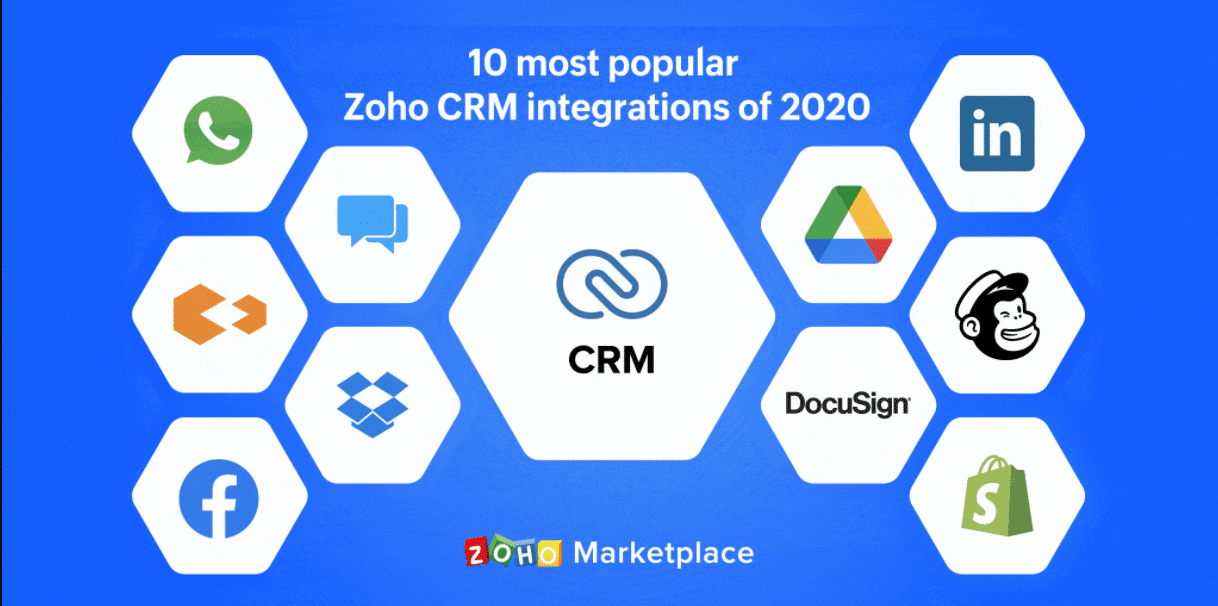
  • Zoho CRM Unveils Their Most Popular Integrations in 2020

    One of Zoho CRM’s features is its ability to easily integrate with other sales tools, which is why they recently revealed a list of the most requested Zoho CRM integrations throughout last year.

    Image via Zoho

    The integrations included in the list cover many bases like chats, SMS, social media, email marketing, ecommerce, cloud storage, and digital signatures. Some of them are WhatsApp Web, Shopify, Google Drive, Facebook Ads Manager, Mailchimp, Dropbox, and DocuSign. These match the most talked about and used sales tools, so it’s no surprise that they all made it into the list.

    To read which other Zoho CRM integrations made it to the list, click here read the full article in Zoho’s blog.

    Are you considering implementing Zoho CRM in your business? Then click here and sign up for a free trial of Zoho CRM.

  • Zoho Named in All 4 Gartner Magic Quadrants

    Zoho Corporation began 2021 looking back at their inclusion in all 4 Gartner Magic Quadrants for 2020, which are highly coveted recognitions in the industry.

    Image via Zoho

    Each year, Gartner, a leading research and advisory company, creates their quadrants. These are, according to them, “a culmination of research in a specific market” that gives a “wide-angle view of the relative positions of the market’s competitors.” To do so, Gartner applies a “graphical treatment and a uniform set of evaluation criteria.” Magic Quadrants have the purpose of helping to quickly determine how well is the execution of the vision stated by each technology provider and how each one is performing against Gartner’s market view.

    Here’s how Zoho was classified in each Magic Quadrant:

    2020 Gartner Magic Quadrant for Enterprise Low-Code Application Platforms: Visionary

    Zoho Creator, which is Zoho’s low-code platform, got this recognition for its design and having the vision of making application development simpler and democratized. Creator is now in its fifth generation (C5) and has helped over 7 million users with its extensive AI capabilities, Deluge tasks, improved form workflows, Progressive Web Apps (PWA), among other features, with easy drag-and-drop deployment.

    2020 Gartner Magic Quadrant for Sales Force Automation: Challenger

    This recognition was won by Zoho CRM, which for 15 years has been helping more than 150,000 mid-sized and large businesses to encourage high velocity sales teams and build long-lasting customer relationships. In their report, Gartner says that “sellers need tools that capture all sales interactions, with fidelity and consistency. They need tools that discern buyers’ intent, measure the prospects’ level of commitment to deals and deliver automated insights particularly leading indicators that are built from the data collected by sellers or from external sources.”
    In this Magic Quadrant, Zoho CRM is featured for its robust lead workflows, the ability to manage complex B2C sales cycles, customization flexibility, high usability scores, as well as solid reporting and analytics.

    2020 Gartner Magic Quadrant for CRM Lead Management: Visionary

    Gartner included Zoho CRM in this quadrant because, according to their report, it’s a lead management application that has predictive capabilities made possible by AI and machine learning. These two increase the efficiency of analytics and processes in lead management. “In order to automate standard processes, these applications unveil correlations and insights that help facilitate the seamless workflow,” says the Gartner report.
    Some of the Zoho CRM features that are relevant to this category are AI powered lead assignment, predictive lead scoring, intelligent workflow automation, and journey orchestration.

    2020 Gartner Magic Quadrant for the CRM Customer Engagement Center: Niche

    In its report, Gartner praises proactive customer service, which Zoho Desk has. According to Gartner’s research, “by 2023, 30% of customer service organizations will deliver proactive customer service using artificial intelligence (AI), process orchestration and continuous intelligence.” Other essential features that Gartner highlighted in Zoho Desk are easy implementation, positive customer feedback on Desk’s capabilities, many integrations with other products, transparent pricing models, and the best value for financial investment.

    Congratulations to our partner Zoho for these wonderful achievements!

    To read the full article, click here.

    Are you interested in learning more about Zoho’s applications or implementing them in your business? Then reach out to us by clicking here. We’ll be happy to help!

This site is registered on wpml.org as a development site. Switch to a production site key to remove this banner.